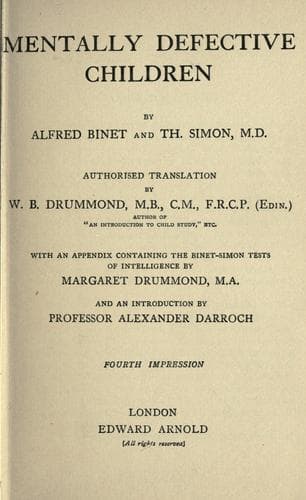
Children with mental disabilities -- Education; Children with mental disabilities -- Psychological testing
The social return consists in the place taken by the pupils in
society. This depends in part, it is clear, upon the educational
return, but only in part. One could imagine a school, and there are
some of the kind, which only cares about producing graduates, without
thinking of what will become of them in life, even if they go to the
dogs. Every class, every school, for defectives ought to aim at
rendering its pupils socially useful. It is not a question of
enriching their minds, but of giving them the means of working for
their living. This is an important question. Upon this depends our
complete and final judgment of the utility of special education.
And be it understood this is not a simple question. Nothing is simple
in the sphere of sociological phenomena, and one cannot get hold of an
atom of truth except by inquiries bristling with difficulties of all
kinds--inquiries whose rules, moreover, are not yet known, but which
will certainly be known some day. It is quite necessary.
In order to discover the social return of an institution, school, or
hospital, there are many data to be brought together. Here are some of
them. What is the number of those who are ultimately able to look
after themselves? For how long a time are they able to do so? To what
extent have they been assisted by what they acquired at school? And,
lastly, what becomes of the failures?
But whatever the social or educational return may be, it would be most
important to know what would have become of similar cases who had
received no such instruction, or, rather, who had been instructed or
treated by different methods.
A single example will show the importance of these reservations.
Recently an alienist wanted to prove that all the idiots, without
exception, who had been treated in his asylum had been improved. He
published copious notes upon these children, which had been taken during
several years by different people--the physician, resident doctor,
attendant, teacher, etc. On reading these observations one learned that
one child, who on admission was unable to walk, by-and-by began to do
so. He had grown; he had also begun to speak, etc. In all this there was
nothing surprising, and we imagine that, in spite of his optimism, the
doctor, who is the author of these observations, would not pretend to
credit an increase in size to his medico-pedagogical treatment. As to
the rest of the development of the faculties we know nothing. It is
possible that an idiot who has ceased to be dirty, or who has learned to
dress himself, would have done so in any case without object-lessons. It
would be necessary to understand the natural development of idiocy in
order to estimate exactly the service which had been rendered by the
medico-pedagogical treatment. Otherwise sceptics will suspect that
three-quarters of what is claimed to be the result of treatment is
really due to nature.
After these preliminaries, let us now turn to our inquiry.
Public-domain text, read in full here on John Shaqi.
Reviews
Reviews
No reviews yet
Be the first to share your thoughts on this work.
Elsewhere in the archive
Join the Discussion
Join the discussion
Sign in to leave a comment or review.
Sign InorCreate an account