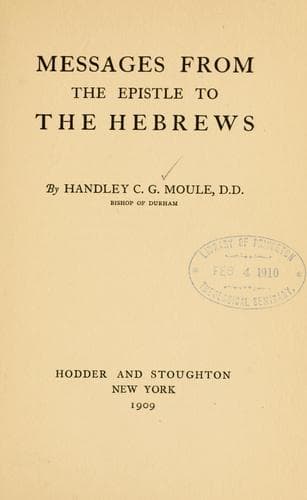
Messages from the Epistle to the HebrewsMoule, H. C. G. (Handley Carr Glyn)
Religion
Messages from the Epistle to the Hebrews
Moule, H. C. G. (Handley Carr Glyn)
Bible. Hebrews -- Commentaries
Produced by Colin Bell, Thomas Strong and the Online
Distributed Proofreading Team at http://www.pgdp.net
{Transcriber's Note: Obvious typographical errors, printing errors and
mis-spellings have been corrected. Any other inconsistencies remain
as they are in the original. Footnotes have been placed at the end of
the paragraph in which they appear.}
MESSAGES FROM THE EPISTLE
TO THE HEBREWS
MESSAGES FROM
THE EPISTLE TO
THE HEBREWS
_By_ HANDLEY C.G. MOULE, D.D.
BISHOP OF DURHAM
LONDON: ELLIOT STOCK
62, PATERNOSTER ROW, E.C.
1909
THE BIBLE IS THE SKY IN WHICH
GOD HAS SET CHRIST THE SUN.
JOHN KER, D.D.
_First Edition May 1909_
_Second Impression July 1909_
PREFACE
The following chapters are the work of intervals of leisure scattered
over a long time. The exposition had advanced some way when an
unexpected call to new and exacting duties compelled me to put it aside
for several years. Accordingly a certain difference of treatment in the
later chapters as compared with the earlier will probably be seen by the
reader, particularly a rather fuller detail in the exposition. But
purpose and plan are essentially the same throughout.
No attempt whatever is made, here or in the course of the work, to deal
with those literary and historical problems which so conspicuously
attach themselves to this Epistle. Who the "Hebrews" were is nowhere
discussed. Nor is any positive answer offered to a question to which
assuredly no such answer can be given, the question, namely, of the
authorship. In my opinion, in face of all that I have read to the
contrary, it still seems at least possible that the _ultimate_ human
author was St. Paul. All, or very nearly all, the objections to his name
which the phenomena of the Epistle _prima facie_ present, and some of
which lie unquestionably deep, seem to be capable of a provisional
answer if we assume, what is so conceivable, that the Apostle committed
his message and its argument, on purpose, to a colleague so gifted,
mentally and by the Spirit, that he might be trusted to cast the work
into his own style. The well-known remark of Origen that only God knows
who "wrote" the Epistle appears to me to point (if we look at its
context) this way. Origen surely means by the "writer" what is meant in
Rom. xvi. 22. Only, on the hypothesis, the amanuensis of our Epistle
was, for a special purpose presumably, a Christian prophet in his own
right.
In any case the author, if not an apostle, was a prophet. And he carries
to us a prophet's "burthen" of unspeakable import, and in words to which
all through the Christian ages the soul has responded as to the words of
the Holy Spirit.
HANDLEY DUNELM.
_Easter, 1909._
CONTENTS
I
PAGE
Public-domain text, read in full here on John Shaqi.
Reviews
Reviews
No reviews yet
Be the first to share your thoughts on this work.
Join the Discussion
Join the discussion
Sign in to leave a comment or review.
Sign InorCreate an account