Messages from the Epistle to the Hebrews — John Shaqi
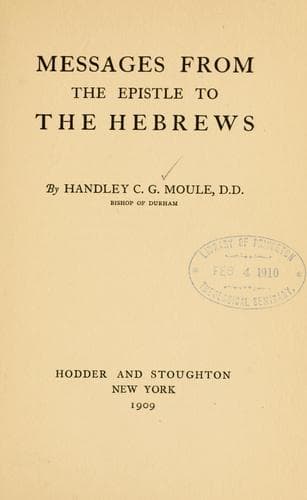
Messages from the Epistle to the HebrewsMoule, H. C. G. (Handley Carr Glyn)
Religion
Messages from the Epistle to the Hebrews
Moule, H. C. G. (Handley Carr Glyn)
Bible. Hebrews -- Commentaries
There is a symmetrical dignity all its own in the seventh chapter of the
Hebrews. I recollect listening, now many years ago, to a characteristic
exposition of it by the late beloved and venerated Edward Hoare, in a
well-known drawing-room at Cromer--a "Bible Reading" full alike of
mental stimulus and spiritual force. He remarked, among many other
things, that the chapter might be described as a sermon, divided under
three headings, on the text of Psalm cx. 4. This division and its
significance he proceeded to develope. The chapter opens with a
preamble, a statement of the unique phenomena which surround, in the
narrative of Genesis, the name and person of Melchizedek. Then, starting
from the presupposition, to whose truth the Lord Himself is so
abundantly a witness, that the Old Testament is alive everywhere with
intimations of the Christ, and remembering that in the Psalm in
question a mysterious import is explicitly assigned to Melchizedek, the
Writer proceeds to his discourse. Its theme is the primacy of the
priesthood embodied in Melchizedek over that represented by Aaron, and
the bearing of this on the glory of Him who is proclaimed a priest for
ever after Melchizedek's order. This theme is presented under headings,
somewhat as follows. _First_ (verses 4-14), the one priesthood is
greater than the other _in order_. Abraham, bearing the whole Aaronic
hierarchy potentially within him, defers to Melchizedek as to his
greater. Hence, among other inferences, the sacred Personage who is a
priest for ever after Melchizedek's order, wholly independent of
Levitical limits, must dominate and must supersede the order of the sons
of Aaron with their inferior status and with their transitory lives.
_Secondly_ (verses 15-19), the one priesthood is greater than the other
in respect of _the finality_, the permanence, the everlastingness, of
the greater Priest and of His office. He is what He is "for ever, on the
scale of the power of indissoluble life."[D] As such, He is the Priest
not of an introductory and transient "commandment" but of that "better
hope" which (ver. 19) has at last "made perfect" the purpose and the
promise, fulfilled the intention of eternal mercy, and brought us, the
people of this great covenant, absolutely nigh to God. _Thirdly_ (verses
20, 21), this second aspect of the supremacy of the greater Priesthood
is emphasized and solemnized by one further reference to Psalm cx. 4.
There the Eternal, looking upon the mysterious Partner of His throne, is
heard not to promise only but to _vow_, with an oath unalterable as
Himself, that the Priesthood of "His Fellow" shall be everlasting. No
such solemnity of affirmation attended Aaron's investiture. There is
something greater here, and more immediately Divine. The "covenant"
(ver. 22) committed to the administration of One thus sealed with the
oath of Heaven must indeed be "better," and cannot but be final; the
goal of the eternal purpose.
[D] [Greek: kata dunamin zoes akatalytou].
Public-domain text, read in full here on John Shaqi.
Reviews
Reviews
No reviews yet
Be the first to share your thoughts on this work.
Join the Discussion
Join the discussion
Sign in to leave a comment or review.
Sign InorCreate an account