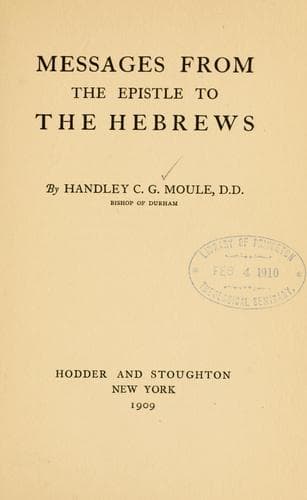
Messages from the Epistle to the HebrewsMoule, H. C. G. (Handley Carr Glyn)
Religion
Messages from the Epistle to the Hebrews
Moule, H. C. G. (Handley Carr Glyn)
Bible. Hebrews -- Commentaries
death-load of unforgiven transgressions, and to lead the Christian in,
as one with his atoning Lord, "to serve a living God," with the happy
service of a worshipper ([Greek: latreuein]) who need "go no more out"
from the Holy Place of peace?
[H] I think the Revisers are right in giving "_now_ present" instead of
"_then_ present" as the rendering for [Greek: ton enestekota] (ver. 9).
The Epistle alludes, so I should conjecture, to the period of its
writing as a time when the sacrifices were still going on, albeit on the
eve of cessation.--It seems best to read [Greek: kath' hen], not [Greek:
kath' hon], in ver. 9; "in accordance with which _parable_."
[I] Possibly we should read [Greek: ton genomenon agathon], "the good
things that are come" (R.V. marg.). But the practical difference is not
great.
But the Teacher has not yet done with the wealth of the Mosaic types of
our full salvation. He has more to say about the profound truth that the
New Covenant needed for its Mediator, its Herald, its Guarantor and
Conveyer of blessing, not a Moses but a Messiah, who could both die and
reign, could at once be Sacrifice and Priest. Covenants, in the normal
order of God's will in Scripture, demanded death for their ratification.
"Where covenant is, there must be brought in the death of the
covenant-victim."[J] So it was with the old covenant (verses 18-21) in
the narrative of Exodus xxiv. So, throughout the Mosaic rules, we find
"remission," practically always, conditioned by "blood-shedding" (ver.
22). Peace with violated holiness was to be attained only by means of
sacrificial death. The terrestrial sanctuary, viewed as polluted by the
transgressions of the worshippers who sought its benefits, required
sacrificial death, the blood of bulls and goats, so to "cleanse" it that
God could meet Israel there in peace (ver. 23). Even so, only after a
higher and holier order, must it be with the better covenant and that
invisible sanctuary where a reconciled God may for ever meet in peace
His spiritual Israel. There must be priestly immolation and an offered
sacrifice; there must be peace conditioned by life-blood shed. And such
is the work of our Messiah-Priest. He has "borne the sins of many" (ver.
28). Presenting Himself (ver. 6) as the Atonement Victim, in the
heavenly Holiest, He has thereby "borne," uplifted ([Greek:
anenenkein]), in that Presence, for pardon and peace, the sins of the
new Israel. And so "the heavenly things" are, relatively to that Israel,
"cleansed"; their God can meet them in that sanctuary with an intimacy
and access free and perfect, because their High Priest and Mediator has
done His work for them. For ever and ever now they need no new
_sacrifice_; His blood, once shed, is eternally sufficient. Aye, and
they need now for ever no repeated _offering_ (ver. 25) of sacrifice, no
new _presentation_ of His blood before the throne, since once He has
taken His place upon it. To offer again He must suffer again (ver. 26).
Public-domain text, read in full here on John Shaqi.
Reviews
Reviews
No reviews yet
Be the first to share your thoughts on this work.
Join the Discussion
Join the discussion
Sign in to leave a comment or review.
Sign InorCreate an account