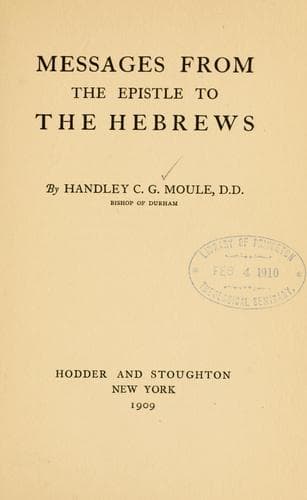
Messages from the Epistle to the HebrewsMoule, H. C. G. (Handley Carr Glyn)
Religion
Messages from the Epistle to the Hebrews
Moule, H. C. G. (Handley Carr Glyn)
Bible. Hebrews -- Commentaries
The heaven-taught Teacher has led us now along the avenue of the
Levitical fore-shadowings, through the prophetic symbolism of the old
high-priesthood, through the holy place and the holiest. The pathway,
marked by the blood of animal sacrifices, hallowing the awful terms of
the covenant of works, has brought us to the true Tabernacle and true
Sacrifice, to the better and final Covenant, to the supreme High Priest.
The teaching has left us, as the ninth chapter closes, "looking up
steadfastly into heaven," recollecting where the Lord is and why He is
there; thinking how we, His Israel, "have Him" for our Representative
and Mediator as He "appears in the presence of God for us," and
expecting the hour of joy and glory when He will put aside the curtains
of that tabernacle, and come forth to crown us with the final
benediction, receiving us "unto the salvation" of eternity (ix. 27,
28).
It is a solemn but a happy attitude. It can be taken by those only who
have "fled for refuge to the hope set before them." But they are to take
it, as those who feel beneath their feet the rock of an assured
salvation and know their open way to the heart of God.
The argument now proceeds in living continuity. Its business now is to
accentuate and develope the supremacy, the ultimacy--if the word may be
allowed--of the finished work of the true High Priest, in contrast to
the provisional and preparatory "law." The Writer has said much to us in
this way before, particularly in the preceding three chapters of the
Epistle. But he must emphasize it again, for it is the inmost purport of
his whole discourse. And he must do it now with the urgency of one who
has in view a real peril of apostasy. His readers are hard pressed, by
persuasions and by terrors, to turn back from Christ to the Judaistic
travesty of the message of the Law. He must tell them not only of the
splendour of Messiah's work but of the absolute finality of it for man's
salvation. To forsake it is to "forsake their own mercy," to "turn back
into perdition."
So he begins with a reminder of the incapacity of the Law to save, by
pointing to the ceaseless _repetition_ of the sacrificial acts. Year by
year, on one Atonement Day after another, the blood-shedding, the
blood-sprinkling, the propitiation, had to be done again. Year by year
accordingly the worshippers were treated as "not perfect" (ver. 1); that
is to say, in the clear light of the context, they were not perfect as
to reconciliation, they were loaded still with the burthen of guilt. The
"conscience of sins" (ver. 2) haunted them still, that is to say, the
weary sense of an unsettled score of offences, a position precarious and
unassured before the Judge.
Public-domain text, read in full here on John Shaqi.
Reviews
Reviews
No reviews yet
Be the first to share your thoughts on this work.
Join the Discussion
Join the discussion
Sign in to leave a comment or review.
Sign InorCreate an account