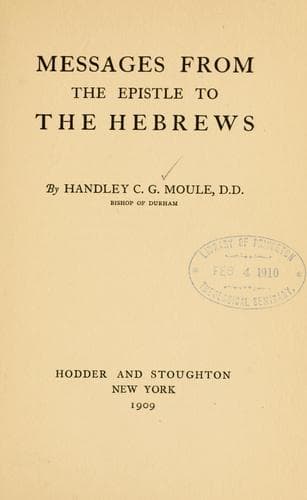
Messages from the Epistle to the HebrewsMoule, H. C. G. (Handley Carr Glyn)
Religion
Messages from the Epistle to the Hebrews
Moule, H. C. G. (Handley Carr Glyn)
Bible. Hebrews -- Commentaries
this deep mass of reasons, the new Israelites are _first_ wholly
accepted for the sake of their self-offered High Priest, that _then_
they may be wholly transformed by His power, working through His peace,
within themselves.
The great closing paragraphs of the chapter (verses 19-39) are one long
application of this sublime finality of the one Offering and this
presentness of our complete acceptance. First, the new Israelite, his
"heart sprinkled from an evil conscience" (ver. 22), released, that is
to say, by the applied Sacrifice from the haunting sense of guilt, and
having his "body washed with pure water," the baptismal sign and seal of
the covenant blessing, is _to behave as what he is_--the child at home.
That home is the Holy Place; it is the very Presence of his God; but _it
is home_. He is to pass into that sanctuary, along the pathway traced by
the blessed blood, not hesitating, but with the "boldness" of an
absolute reliance, perfectly free while perfectly and wonderingly
humbled; "with a true heart, in fulness, in full assurance, of faith"
(ver. 22). He is to hold fast his avowal of assurance, and meanwhile he
is to animate the brethren round him to a holy rivalry (ver. 24) of love
and zeal. He is to maintain all possible worshipping union with them, in
the dawning light of the promised return of the now enthroned High
Priest (ver. 25).
Then, further, the new Israelite is to cherish the grace of godly fear.
The "boldness" of the loyal child is to go along with the clear
recollection that outside the holy home there lies only "a wilderness of
woe." To leave it, to turn back from it, to be a renegade from covenant
joys, is no mere exchange of the best for the less good. It means
multiplied and capital rebellion. No legal shadow-sacrifices will
shelter now the soul that forsakes the eternal High Priest and casts His
Self-Sacrifice aside. To do that is to set out towards a hopeless
retribution, towards the fire of judgment, the vengeance of the living
God (verses 26-31).
Public-domain text, read in full here on John Shaqi.
Reviews
Reviews
No reviews yet
Be the first to share your thoughts on this work.
Join the Discussion
Join the discussion
Sign in to leave a comment or review.
Sign InorCreate an account