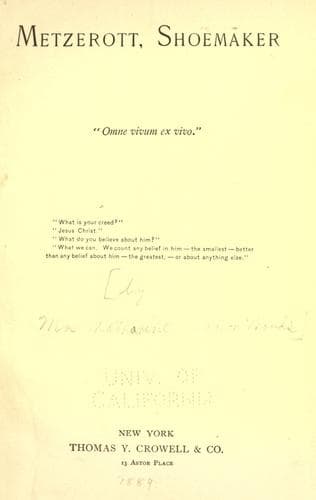
Christian socialism -- Fiction; German Americans -- Fiction; Shoemakers -- Fiction
X. PREACHING AND PRACTICE 261
BOOK III.
_FLOOD AND FIRE._
I. “O’ER CRAG AND TORRENT, TILL THE NIGHT IS GONE,” 277
II. “POLLY, PUT THE KETTLE ON” 288
III. PANSIES 297
IV. VÆ VICTIS. 314
V. AN EXPERIMENT 328
VI. THE FRAGRANCE OF TEA-ROSES 334
VII. “THESE, THROUGH THEIR FAITH, RECEIVED NOT THE PROMISE” 346
VIII. “THAT, APART FROM US, THEY SHOULD NOT BE MADE PERFECT” 368
BOOK I.
LOVE.
METZEROTT, SHOEMAKER.
CHAPTER I.
KARL METZEROTT ATTENDS A KAFFEE KLATSCH.
Karl Metzerott, shoemaker, counted himself reasonably well-to-do in the
world. It was a favorite saying of his (though he was not greatly given
to sayings at any time, his days being so full of doings), that his
Socialist opinions were not based upon his own peculiar needs; and that,
when the Commune should supervene, as he fervently believed it must some
day, he, Karl Metzerott, would be numbered rather among its givers than
its receivers.
In truth, he had some reason for self-gratulation. He was young, strong,
and able to earn a fair living at his trade; and his wife,—but stop! We
have not come to her quite yet.
The shop where he bent over his lapstone for ten hours a day, excluding
meal times, was an odd-looking structure, in a poor quarter of a city
which we shall call Micklegard; and which, if any one should strive to
locate, we warn him that the effort will bring him only confusion of
face and dire bewilderment. For its features may be recognized, now
here, now there, like those mocking faces that peered at Ritter
Huldbrand through the mists of the Enchanted Forest.
The shoemaker’s dwelling contained but three rooms. The front, a
shingled frame building of one story, presented its pointed gable at the
street like a huge caret, denoting that all the sky and stars, perhaps
something further, were wanted by those beneath. This was the shop;
behind it were the kitchen, looking out upon a small square yard,
opening on a not over-clean alley; and a bedroom above, whose front
window peered over the gable roof, between the high blank walls of the
adjoining houses, while the opposite one kept watch from the rear: and
each, in its curtainless bareness, looked equally desolate and
unsatisfied.
Public-domain text, read in full here on John Shaqi.
Reviews
Reviews
No reviews yet
Be the first to share your thoughts on this work.
Join the Discussion
Join the discussion
Sign in to leave a comment or review.
Sign InorCreate an account