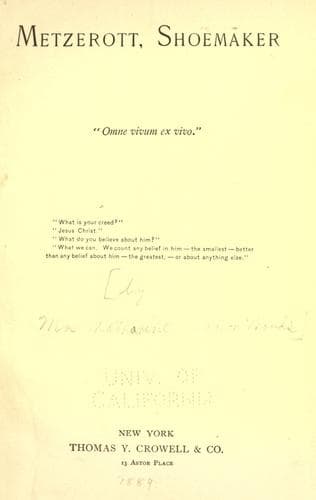
Christian socialism -- Fiction; German Americans -- Fiction; Shoemakers -- Fiction
And so they were married by the Episcopal clergyman, who in the morning
of the same day had united Frederick and Alice; selected by Dora,
indeed, for that very reason; a clergyman of the old, indolent sort, now
happily almost unknown, who married all that were set before him,
pocketed his fee, and asked no questions for conscience sake. He shall
not trouble the reader again, and is of importance here only because,
having been Alice’s pastor all her life, she was not likely to have been
aroused by his walk or conversation to any consciousness of the deep
things of the spiritual life.
After the ceremony, the happy pair and their friends, who had witnessed
the marriage, partook of a social tea, for which Frau Kellar provided
house-room, and the bridegroom paid; then, husband and wife went home to
their little three-roomed dwelling, and the new life began.
And then—for a while—how Karl would have laughed at any pessimistic
theories. As for Dora, she would not have known a theory of any
description, if she had stumbled across one. But she was very, very
happy, our little Dora! Life had not been easy to her,—an orphan,
maintained and educated by grudging fraternal care, and with her early
hope nipped, in its first flower, by the frost of death. Now, surrounded
by love, her nature blossomed into a wonderful luxuriance; the wistful
blue eyes grew full of laughter, the sad lips smiled, and the cheeks
grew rosy. She was as merrily busy all day long as a child at play; and
Frau Metzerott the elder found her a daughter beyond her dreams.
Shoemaker Karl said little; but no king upon his throne ever more
intensely believed his wife a queen among women. All day he could hear
her blithe, sweet voice, singing over her work, or chatting and laughing
with his mother, who had suddenly failed, now that she had some one to
rest her cares upon. It mattered little, she said; Dora was eyes, hands,
and feet to her; she had worked hard enough in her time, now she could
rest. And so she lay and rested under her gay, patchwork quilt, upon her
testered bed, while Dora bustled cheerfully about the tiny kitchen. In
the evening, when work was over, she would often draw the old
candle-stand to the bedside, and, with the yellow lamplight shining on
her golden hair, read aloud from the heavy yellowed pages of the old
German Bible, while Karl sat near with his pipe. Not that he listened,
except to the soft murmur of his wife’s sweet voice; yet the unheeded
words returned to him in after years, stirring always a new throb of
misery.
But at the time the Bible-reading served as a not unpleasant
accompaniment to his pipe, which he would not for worlds have disturbed
or interfered with. “Religion was an excellent thing for women,” said
Karl Metzerott.
Public-domain text, read in full here on John Shaqi.
Reviews
Reviews
No reviews yet
Be the first to share your thoughts on this work.
Join the Discussion
Join the discussion
Sign in to leave a comment or review.
Sign InorCreate an account