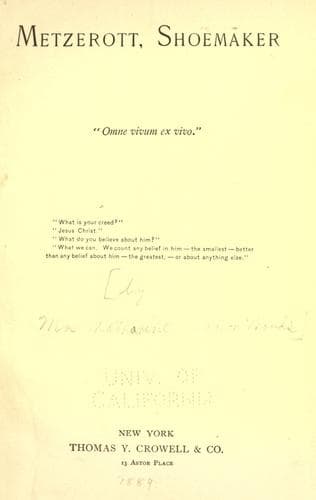
Christian socialism -- Fiction; German Americans -- Fiction; Shoemakers -- Fiction
Karl Metzerott had a certain reputation in his own quarter of Micklegard
for the excellence of his work. His shoes were not fancy shoes, he was
wont to say, but he used only the best leather, and they were every
stitch hand-made. One pair of them would outlast two pairs of
machine-made shoes, he said, and then be half-soled to look as good as
new. But there was no denying that the machine-made shoes were cheaper
to begin with, whatever they might be in the end; and when business is
bad all over the country, money as tight as wax, and the air filled with
rumors of a general financial crisis, and complaints of
over-production,—whatever that may be,—why, people will wear the
cheapest things they can find. Perhaps they reason that the sooner the
things wear out the sooner will the demand catch up with the supply, and
the evil of over-production be remedied; or perhaps it is simply that if
a man have five dollars to buy shoes for his entire family, he must make
it go as far as it will, rather than spend it all on one member (or pair
of members), letting the rest go barefoot. As to what he shall do when
the cheap shoes are gone, why, he must just resort to the expedient of
which the rest of us avail ourselves when everything else has proved
unsuccessful,—he must trust in Providence.
Whatever the cause, Metzerott saw his best customers pass his door in
machine-made shoes; but he did derive a sort of cynical pleasure from
noticing how soon the shoes were brought to him to be mended and
patched.
“I must work over hours, and lower my prices,” he said to Dora; and,
though the latter could not quite understand why he must overwork, when
rows of unsold shoes stood upon his shelves, she made no objection, as
the idea seemed to comfort him.
Lowering the prices, however, had an excellent effect; and though the
shoes were sold at little more than cost, it was certainly less
depressing than to see them hanging there so helplessly, or staring from
the shelves with their toes turned out in the first position, in such an
exasperating manner.
Anna Rolf also felt the hard times, even more than the Metzerotts, since
“every woman her own dressmaker” is an easier problem to solve than how
to make one’s own shoes. Leppel had been discharged at last,—got the
sack, as he expressed it; not before he had richly earned, as one might
candidly admit, all that the sack might contain. But oh! for the
innocent who suffer with the guilty, in this world of ours! There is
never a jewelled cup of gold in the mouth of any sack for them.
Leppel’s family bade fair to have very little in their own mouths for a
while, with the father out of work, and Anna expecting to be again laid
aside from hers for a season. “But you have no rent to pay, that is one
thing,” said Dora comfortingly, “and we will take care of the children,
Karl and Louis and I. Do you suppose I can forget how good you were to
me?”
Public-domain text, read in full here on John Shaqi.
Reviews
Reviews
No reviews yet
Be the first to share your thoughts on this work.
Join the Discussion
Join the discussion
Sign in to leave a comment or review.
Sign InorCreate an account