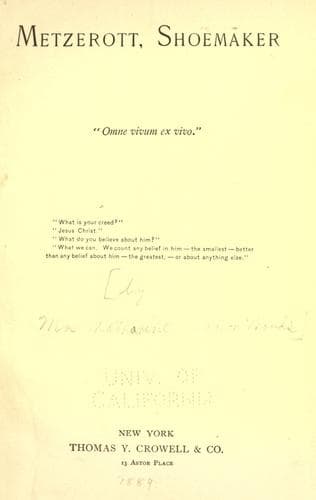
Christian socialism -- Fiction; German Americans -- Fiction; Shoemakers -- Fiction
“It is expensive inventing,” said the young one, her brilliant face
darkened by a shadow of real anxiety. “But, however, he must have his
own way, and the money is his. So he was off from the Hall, when he had
had his supper, and of course,” with a conscious laugh—“he would not
leave me there without him.”
“No, no,” said the Frau, her withered lips expanding into a toothless
smile, “you are much too pretty for that, Aenchen.”
“The new pastor was there,” said Anna, when she had playfully shaken the
old woman by her bowed shoulders, in acknowledgment of this remark,
“and, I think, the Frau Pastorin that will be.”
“So?” exclaimed the old woman eagerly; “who is she, Anna?”
“She came over on the same steamer as the Herr Pastor, and her name is
Dorothea Weglein. It seems she had a sweetheart here in Micklegard, and
came over to be married to him; but when she arrived he had died in the
mean time, of something or other, very sudden, I don’t know what.”
“Poor child! And the Herr Pastor is courting her?”
Anna shrugged her shoulders. “It looks like it,” she said. “It seems she
got a service place after her _Schatz_ died. The Herr Pastor could do
better than that. But some one else was taken with her baby face and
frightened ways, Frau Metzerott. Your son was eating her up with his
eyes when I came away.”
“Did her _Schatz_ leave any money behind him?” asked the Frau.
Anna laughed a little shrilly, as she moved towards the door. “You know
they weren’t married, Mütterchen; so, if he did, it probably went to his
relations. Well, it is two years since it happened; she will be easily
consoled. Good-night, Fritz will be wanting me. I only ran over to tell
you the news,” and she was gone, leaving the shop and kitchen darker and
stiller than ever, by contrast.
Karl Metzerott, meanwhile, had walked briskly enough to meet his fate,
but with small thought of new Herr Pastors or possible Frau Pastorins.
He was his mother’s own son in appearance, every one had said, when both
were younger; at present, the resemblance was less striking. Karl was a
man of nearly thirty, who looked older than his years; of average
height, strongly and squarely made, the shoulders slightly rounded by
his occupation, the head a little large, with a fine, square brow, and a
thick covering of coarse black hair. The eyes were keen and clear, the
features strong and rugged. The skin was dark, not particularly fine,
but clear and healthful; he wore neither beard nor mustache, and his
manner showed no slightest consciousness of himself or his Sunday
clothes.
Public-domain text, read in full here on John Shaqi.
Reviews
Reviews
No reviews yet
Be the first to share your thoughts on this work.
Join the Discussion
Join the discussion
Sign in to leave a comment or review.
Sign InorCreate an account