Produced by Curtis Weyant, Louise Pryor and the Online
Distributed Proofreading Team at http://www.pgdp.net (This
file was produced from images generously made available
by Case Western Reserve University Preservation Department
Digital Library)
{Transcriber's note:
~Bold~ text is surrounded by tildes ~, _italic_ text by underscores _.
The use of é and è to indicate stresses is inconsistent in this
text, as is the use of œ and æ ligatures. No changes have
been made to the original.
}
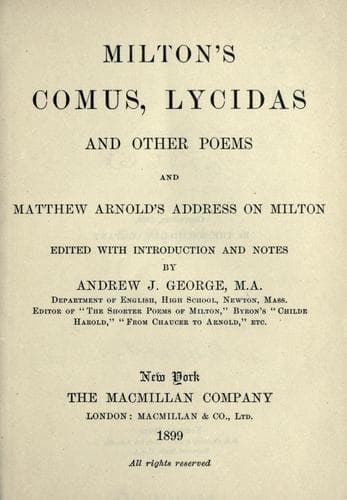
MILTON'S COMUS
WITH
INTRODUCTION AND NOTES
BY
WILLIAM BELL, M.A.
PROFESSOR OF PHILOSOPHY AND LOGIC, GOVERNMENT COLLEGE, LAHORE
London
MACMILLAN AND CO
AND NEW YORK
1891
[_All rights reserved_]
First Edition, 1890.
Reprinted, 1891.
CONTENTS.
PAGE
INTRODUCTION, vii
COMUS, 7
NOTES, 38
INDEX TO THE NOTES, 113
INTRODUCTION.
Few poems have been more variously designated than _Comus_. Milton
himself describes it simply as "A Mask"; by others it has been
criticised and estimated as a lyrical drama, a drama in the epic style,
a lyric poem in the _form_ of a play, a phantasy, an allegory, a
philosophical poem, a suite of speeches or majestic soliloquies, and
even a didactic poem. Such variety in the description of the poem is
explained partly by its complex charm and many-sided interest, and
partly by the desire to describe it from that point of view which should
best reconcile its literary form with what we know of the genius and
powers of its author. Those who, like Dr. Johnson, have blamed it as a
drama, have admired it "as a series of lines," or as a lyric; one
writer, who has found that its characters are nothing, its sentiments
tedious, its story uninteresting, has nevertheless "doubted whether
there will ever be any similar poem which gives so true a conception of
the capacity and the dignity of the mind by which it was produced"
(Bagehot's _Literary Studies_). Some who have praised it as an allegory
see in it a satire on the evils both of the Church and of the State,
while others regard it as alluding to the vices of the Court alone. Some
have found its lyrical parts the best, while others, charmed with its
"divine philosophy," have commended those deep conceits which place it
alongside of the _Faerie Queen_, as shadowing forth an episode in the
education of a noble soul and as a poet's lesson against intemperance
and impurity. But no one can refuse to admit that, more than any other
of Milton's shorter poems, it gives us an insight into the peculiar
genius and character of its author: it was, in the opinion of Hallam,
"sufficient to convince any one of taste and feeling that a great poet
had arisen in England, and one partly formed in a different school from
Public-domain text, read in full here on John Shaqi.
Reviews
Reviews
No reviews yet
Be the first to share your thoughts on this work.
Join the Discussion
Join the discussion
Sign in to leave a comment or review.
Sign InorCreate an account