Mine Pumping in Agricola's Time and Later — John Shaqi
Mine Pumping in Agricola's Time and LaterMulthauf, Robert P.
History
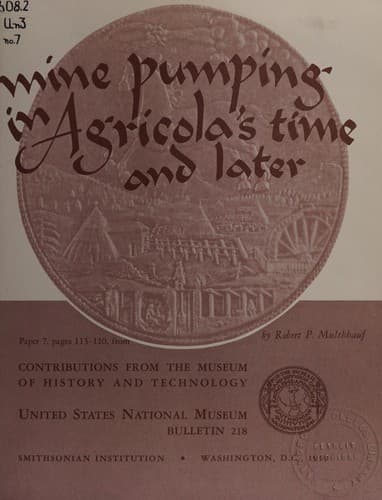
Mine Pumping in Agricola's Time and Later
Multhauf, Robert P.
Mine pumps -- History; Mining machinery -- History
This revival appears to have paralleled in general the political and
cultural revival, but, as in any mining region, the exhaustion of easily
workable surface deposits marked a critical point, when the necessity of
deeper mining led to the construction of supported tunnels and the
introduction of machinery for removing ores and water from deep mines.
On the basis of revisions of capital structure and mining law which he
regards as inspired by the financial necessities of deep mining, Bechtel
dates this development from the mid-14th century.[4] The mid-14th
century situation is confused by the occurrence of the Black Death,
which reduced mining activity drastically, and the events of which
Bechtel speaks have been put as much as a century later.[5] In any case,
the development of deep-mining methods had clearly made considerable
progress in nonferrous mines when the _De re metallica_ was written, in
1556.
[Illustration: Figure 1.--BRUNSWICK SILVER 3-1/2 TALER, Johann
Friedrich, 1677. (_U. S. National Museum, Paul A. Straub coll.;
Smithsonian photo 43334-C._)]
MINE-PUMPING MACHINERY ILLUSTRATED BY BRUNSWICK MULTIPLE TALERS
These large silver coins weighing up to 15 ounces were first issued
in 1574 in Brunswick by Duke Julius (1568-1589) of the Wolfenbuttel
line. Their historical background is rather unusual and interesting.
In 1570 the Duke decided to increase the output of his silver mines
in the Harz and arranged for the opening of three new mines. In
order to insure the retention of a portion of this increased silver
output under his control, the Duke decided to issue an entirely new
kind of silver coin which he called "Loeser," meaning redeemer.
These were larger than taler-size pieces, and were struck in
denominations from 1-1/4 to 16 talers. The Duke ordered that each of
his subjects was to purchase one of these large coins, the size of
the coin to be acquired depending on the individual's wealth. The
owners were not allowed to use these pieces in everyday trade, but
could pawn them in case of dire need. They were expected to produce
them at any time upon demand. Thus a means of hoarding, a "treasure
piece," was created, and the risk of draining the country's wealth
through replacement of good, full-weight silver coins with imported
base currency was to some extent limited. At the same time, the Duke
had a considerable sum of money at his disposal in case of
emergency.
Public-domain text, read in full here on John Shaqi.
Reviews
Reviews
No reviews yet
Be the first to share your thoughts on this work.
Join the Discussion
Join the discussion
Sign in to leave a comment or review.
Sign InorCreate an account