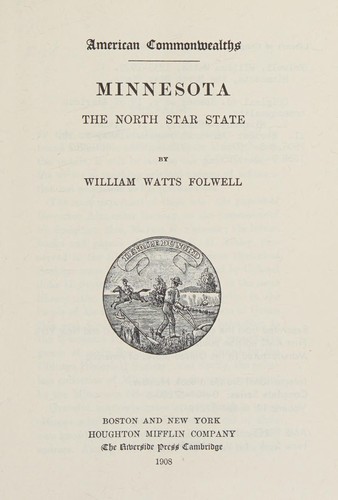
Minnesota, the North Star StateFolwell, William Watts
History
Minnesota, the North Star State
Folwell, William Watts
Minnesota -- History
Brackett’s Cavalry Battalion of three companies, to which a fourth was
added January 1, 1864, was recruited in the fall months of 1861, and
remained in service till May, 1866. The command, by services
appropriate to its arm, contributed not a little to the victories of
Fort Donelson, Shiloh, and Corinth. It accompanied Sully’s Indian
expedition to the upper Missouri in 1864, and took part in the battle
of Killdeer Mountain. Stationed on the right of the line, the battalion
checked a fierce flank attack, which it followed with a gallant
counter-charge, inflicting heavy loss on the savages.
The First Battery of Light Artillery was mustered in at Fort Snelling,
November 21, 1861, and sent south in midwinter to join Sherman’s
division at Pittsburg Landing, Tennessee. In the battle of Shiloh,
April 6, 1862, this battery, forced back with Prentiss’s routed
division, united in the heroic stand at the point known as “the
hornet’s nest,” which held back the enemy’s advance till Grant’s
disordered regiments could be formed for final and effective defense.
Captain Emil Munch had his horse shot under him and was severely
wounded. The Second Light Battery was not accepted till March 21, 1862.
Its commander, Captain William A. Hotchkiss, had seen service as an
artilleryman in the Mexican War. At Perrysville and Stone River this
command played a gallant part, fortunately with small loss.
The passage of the enrollment act of April 16, 1862, indicated an
expectation that to reëstablish the authority of the government over
all territory, an increase of the army would be necessary, and that the
raising of new troops might not be left to the pleasure or convenience
of the states. On the day of McClellan’s escape to the James River
(July 2) President Lincoln called for 300,000 volunteers. Minnesota’s
quota was 5362. On August 4 this call was followed by an order for
drafting 300,000 men from the loyal states. Volunteering, which for
some months had gone but languidly forward, revived. Public meetings
were held in all the towns; bounties were offered by citizens and
municipal bodies; splendid examples of patriotic sacrifices were set by
men who could ill afford them, and could ill be spared by the
communities. The actual recruiting was mainly done by gentlemen who
were promised commissions in consideration of their services. The
distribution of the quotas to counties and towns really set the whole
people at work, with the result that before the harvest was over five
new regiments, the Sixth, Seventh, Eighth, Ninth, and Tenth, were
substantially filled. However, it was not till November 19 that the
announcement could be made that every local quota had been filled and
that all danger of the draft, from time to time deferred, was averted.
The immediate employment of all these regiments was, as we are to see,
far different from the expectations of the recruits. The appointments
to the field and staff positions were no easy task for Governor Ramsey.
Public-domain text, read in full here on John Shaqi.
Reviews
Reviews
No reviews yet
Be the first to share your thoughts on this work.
Elsewhere in the archive
Join the Discussion
Join the discussion
Sign in to leave a comment or review.
Sign InorCreate an account