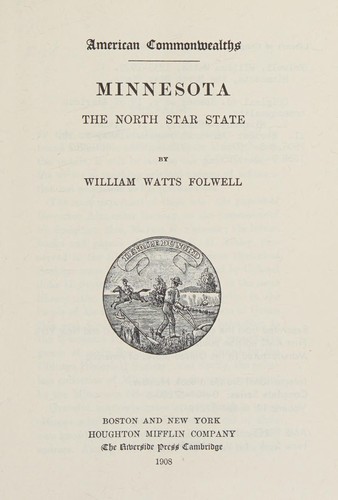
Minnesota, the North Star StateFolwell, William Watts
History
Minnesota, the North Star State
Folwell, William Watts
Minnesota -- History
It was well known that he would desire the legislature of 1863 to elect
him to succeed the Hon. Henry M. Rice as United States senator, and
that another aspirant was at least equally desirous. His personal
admirers urged him to distribute the military “plums” in a way helpful
to his political success. His political opponents were prophesying that
he would certainly do so, and charged him with selfishness,
heartlessness, and disregard of experience. To the head of one regiment
he appointed William Crooks, an experienced civil engineer, who had
been two years at West Point and was his political opponent. For three
other regiments he took Lieutenant-Colonels Miller, Wilkin, and Thomas
from the First, Second, and Fourth Minnesota regiments respectively.
CHAPTER XI
THE OUTBREAK OF THE SIOUX
While the whole people of Minnesota were striving night and day to fill
up the new regiments with volunteers to reinforce the national armies,
there was trouble brewing within their own boundaries. The reader will
have observed that small garrisons had been and were still maintained
on the Indian frontiers. There was one at Fort Ripley, below Crow Wing,
to protect the Chippeway agency; there were two on the borders of the
Sioux reservations. Of these one occupied Fort Ridgely, situated on the
north bank of the Minnesota River in the extreme northwest corner of
Nicollet County. It was begun in 1853 when the lower Sioux were
arriving on their reservation. The garrison had for its purpose the
support of the authority of the government agents thereon. Another post
had previously been established on the west bank of the Red River, some
fifteen miles north of Breckenridge, chiefly for the purpose of
protecting the Red River trade, carried in hundreds of single ox carts,
from depredations of both Sioux and Chippeways, whose hunting parties
waylaid not only one another, but the white man’s caravans. Fort
Abercrombie, although at some distance from the upper reserve, was near
enough to keep the upper Sioux aware of the Great Father’s power.
Although called forts, no one of the three was in any sense a strong
place. Each consisted of a group of detached buildings standing on the
open prairie. The lapse of years in quiet seemed to justify the
assumption that it would be a useless thing to form a proper inclosure
and fortify it.
Public-domain text, read in full here on John Shaqi.
Reviews
Reviews
No reviews yet
Be the first to share your thoughts on this work.
Elsewhere in the archive
Join the Discussion
Join the discussion
Sign in to leave a comment or review.
Sign InorCreate an account