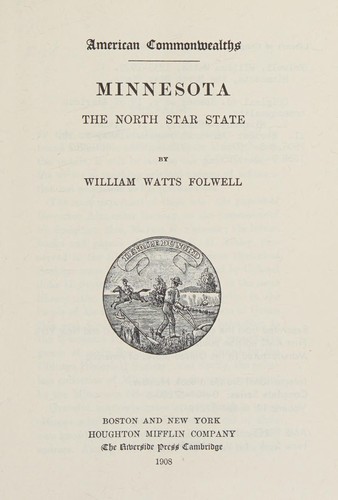
Minnesota, the North Star StateFolwell, William Watts
History
Minnesota, the North Star State
Folwell, William Watts
Minnesota -- History
The Minnesota Sioux betook themselves to the reserves designated in the
treaties of 1851 in no comfortable frame of mind. They believed that
they had been obliged to abandon their ancient homes for an inadequate
compensation, and that government agents had conspired with the traders
and half-breeds to cheat them of money promised to be paid to their
chiefs. Two years passed before they were assured by act of Congress
that they would be allowed to remain in Minnesota and not sent to some
far-off unknown country. The treaty commissioners of 1851 congratulated
the government on the establishment of a policy of “concentration,”
under which the Indian would be induced to abandon the chase and get
his living from the soil. The Pond brothers, foreseeing that this
policy was premature, decided not to follow the tribes among whom they
had labored to the reservations. Concentration of wild Indians averse
to cultivation only gave opportunity for unceasing grumbling in council
over the general rascality of the white man, the tyranny of the agent,
the immorality of his employees, the extortions of the traders, and the
imbecility of the missionaries, who worked for nothing.
In the buffalo season these Sioux swarmed out into the Missouri valley
to make boot upon the still countless herds. At times some wandered
back to their old homes below. The reservations, while ample in area
for eight thousand Indians, were in shape ridiculously ill-adapted for
concentration. Originally they formed a “shoestring” one hundred and
fifty miles long and twenty miles wide. That width had been reduced by
the treaties of 1858 to ten miles. There was no privacy for the Indian.
An easy morning walk took him to the boundary, where the accommodating
white man met him with a keg of illicit whiskey. This opportunity for
“business” doubtless had no little effect in attracting settlers to the
lands fronting on the reservations. The citizens of Brown County in
1859 publicly denounced the criminal practice, and the county
commissioners offered a reward of twenty-five dollars for evidence
leading to conviction in any prosecution. While generally harmless, the
Indians annoyed the settlers by untimely visits for food, and
occasional thefts of horses and cattle.
Public-domain text, read in full here on John Shaqi.
Reviews
Reviews
No reviews yet
Be the first to share your thoughts on this work.
Elsewhere in the archive
Join the Discussion
Join the discussion
Sign in to leave a comment or review.
Sign InorCreate an account