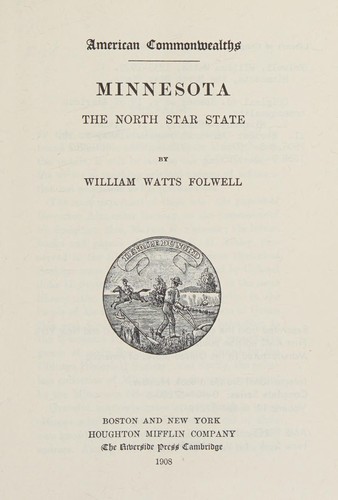
Minnesota, the North Star StateFolwell, William Watts
History
Minnesota, the North Star State
Folwell, William Watts
Minnesota -- History
The two conflicts,—the Civil War and the Indian war,—occupying the
minds of the people of Minnesota for four years, naturally overshadowed
all other interests. The Democratic party long in control of her public
affairs, depleted by the desertion of thousands of young men to the
ranks of the more obtrusively patriotic Republican organization, was
left so reduced in numbers as to be powerless in state and national
politics. The reëlection of Governor Ramsey in the fall of 1861 was a
foregone conclusion. If the Republicans were relieved from competition
with a powerful opposition they found plenty of it between the factions
which arose in their own camp. At the first, however, they were none
too sure of carrying a sufficient number of election precincts and
therefore felt justified in resorting to a procedure never anticipated
by the framers of the state constitution. The legislature in the
special session of September, 1862, by a statute duly approved,
provided against the disfranchisement of those citizens who at the time
of election should be absent in the military service. The plan adopted
was that of sending commissioners to the camps to open polls and
receive the ballots of soldiers who were, or claimed to be, qualified
electors. These ballots they sealed up and transmitted by mail to the
judges of election at the respective residences of the absentee voters.
The scheme was carried out with the expected result of sufficient
Republican majorities. William Windom was easily reëlected
representative in the first congressional district, and Ignatius
Donnelly, the lieutenant-governor, got his first election in the
second. The state was not yet entitled to more than two
representatives. Much greater interest, however, centred in the
election of a legislature for 1863, which would have before it the
choice of a United States senator to succeed Henry M. Rice, whose term
was to expire. Governor Ramsey was the logical candidate, and he did
not affect indifference to the promotion. The other principal aspirant
was Cyrus Aldrich of Minneapolis, who had been representing the second
district in Congress in a very acceptable manner. Mr. Aldrich’s
legislative experience in Minnesota and another state warranted his
friends in promoting his candidacy. These formed a body which in a
later day would have been designated as “stalwart” Republicans; they
were dissatisfied with the alleged inertia of Lincoln’s administration,
and desired the liberation of the Southern slaves and the prosecution
of the war with greater energy. Mr. Ramsey, by his nature conservative,
stood by the administration.
Public-domain text, read in full here on John Shaqi.
Reviews
Reviews
No reviews yet
Be the first to share your thoughts on this work.
Elsewhere in the archive
Join the Discussion
Join the discussion
Sign in to leave a comment or review.
Sign InorCreate an account