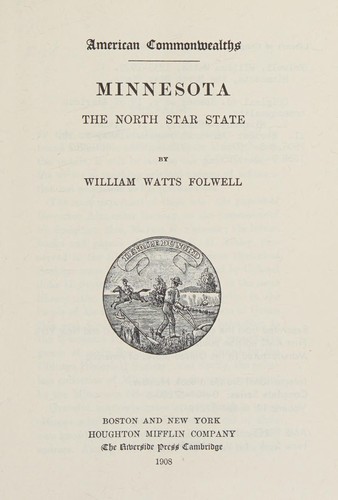
Minnesota, the North Star StateFolwell, William Watts
History
Minnesota, the North Star State
Folwell, William Watts
Minnesota -- History
The first trial of strength came off in the Republican legislative
caucus held immediately after organization, early in January, 1863. The
number of votes was forty-six, and twenty-four votes were necessary to
the choice. On the first balloting Mr. Ramsey received but nineteen
votes, and then twenty votes for nineteen successive ballotings.
Fortunately “the field” was rigidly divided. On the twenty-fourth
balloting, twenty-three votes were cast for Ramsey, and the caucus
adjourned with little expectation of further changes. A final trial,
however, gave twenty-six votes and assured the election of Governor
Ramsey by the houses in joint convention on January 14.
Although his senatorial term began March 4, 1863, Governor Ramsey
remained in office till July, when he retired to attend an extra
session of the Senate. Lieutenant-Governor Donnelly had resigned at the
close of the legislative session of 1863, and the state senate had
elected as their president _pro tempore_, the Hon. Henry A. Swift of
St. Peter. Under constitutional provision Mr. Swift became
lieutenant-governor in room of Mr. Donnelly, and on July 10 (1863)
governor, in the place of Mr. Ramsey. Governor Swift held the office
for the remaining six months of Ramsey’s term, making no effort to
succeed himself. Contemporaries speak of him as a man of singularly
amiable character, preferring a quiet life among his neighbors to the
excitements of the capital. He was succeeded in office by General
Stephen Miller, a native of Pennsylvania, who came to the state in 1868
and made his home in St. Cloud. He had been an ardent supporter of Mr.
Ramsey, who was not indifferent to his claims upon him. Upon the
organization of the First Minnesota Infantry Mr. Miller received the
appointment of lieutenant-colonel. He devoted himself with such
fidelity to military studies and exercises that he soon became
sufficiently expert, and at Bull Run, Fair Oaks, and other engagements
proved beyond question his personal courage. Such was his modesty,
however, that when the colonelcy of the First became vacant, a first,
second, and even third time he preferred to have it filled by
experienced regular officers. After the Seventh Regiment was formed
Governor Ramsey was pleased to make him its colonel. When General
Sibley in the late fall of 1862 left the front to assume command of his
district he devolved immediate command on Colonel Miller. During the
general’s absence in the campaign to the Missouri in 1863 Colonel
Miller remained at St. Paul in command of the district. Nominated and
elected as governor in the fall of that year and honored with the
brevet rank of brigadier-general, Colonel Miller resigned to take up
his civil duties. In the first year of his service he was chiefly
employed in filling up the state’s quota in the armies of the Union;
and he was so much grieved and disgusted with the behavior of those
drafted men who did not report for duty that he seriously recommended
Public-domain text, read in full here on John Shaqi.
Reviews
Reviews
No reviews yet
Be the first to share your thoughts on this work.
Elsewhere in the archive
Join the Discussion
Join the discussion
Sign in to leave a comment or review.
Sign InorCreate an account