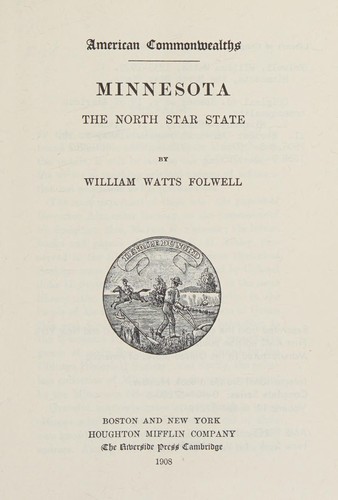
Minnesota, the North Star StateFolwell, William Watts
History
Minnesota, the North Star State
Folwell, William Watts
Minnesota -- History
The removal of the state capital from St. Paul, which would have been
accomplished in 1857 but for the high-handed exploit of Councilor
Rolette, though frequently broached informally, was not seriously taken
up by any legislature till 1869. A bill for removal to Kandiyohi
County, on to land belonging to the state, was passed through both
houses so easily and rapidly as to invite the surmise that the
necessary votes had been secured in advance. Superfluous debate was
shut out by the operation of the previous question. The vote in the
house was 39 to 7, that in the senate 12 to 10; but the house could not
muster enough votes to pass the bill over Governor Marshall’s veto. The
veto message was moderate in tone; suggesting that it would be wise to
hear from the people on the question, that there should be no haste
about a final location of the capital, and that it was no time to
expend a great sum of money on buildings.
Two years later a final proposal to remove the capital from St. Paul to
the imagined city of Stanton met with a prompt indefinite postponement.
CHAPTER XVI
STORM AND STRESS
Horace Austin was inaugurated governor January 9, 1870. A native of
Connecticut, who had lived and married in Maine, he had come to
Minnesota in 1855 at the age of twenty-five and settled at St. Peter.
He had studied law and taught school, but had taken no college course.
In the campaign of 1863 against the Sioux he commanded a company of
Minnesota Mounted Rangers and gave a good account of himself on the
march and battlefield. His neighbors had elected him a district judge
and were more than content with his wise and fearless conduct on the
bench. It was a piece of good fortune for the state that the warring
Ramsey and Donnelly factions of the Republican party in the convention
of 1869 compromised upon a candidate unobjectionable to both, but no
especial favorite with either. His majority was less than two thousand
over the popular candidate of the Democrats, George L. Otis. Ingenious,
hopeful, independent, Mr. Austin in successive messages showered upon
the legislatures projects of reform and development. In many of them he
was doomed to disappointment because he relied entirely on the merit of
propositions, and was not politician enough to understand that it is
only by timely and happy combination of interests that measures can be
carried in legislative bodies. Among these abortive recommendations may
be mentioned the one in his second message, urging a revision of the
state constitution, which he declared to be a motley of
inconsistencies. His desire was that a revised constitution should
contain such provisions as these: (1) Restriction of special
legislation; (2) prohibition of exclusive franchises; (3) limitation of
local taxation; (4) restriction of municipal debts; (5) ample power to
regulate railroads; and (6) abolition of the grand jury. Neither the
Public-domain text, read in full here on John Shaqi.
Reviews
Reviews
No reviews yet
Be the first to share your thoughts on this work.
Elsewhere in the archive
Join the Discussion
Join the discussion
Sign in to leave a comment or review.
Sign InorCreate an account