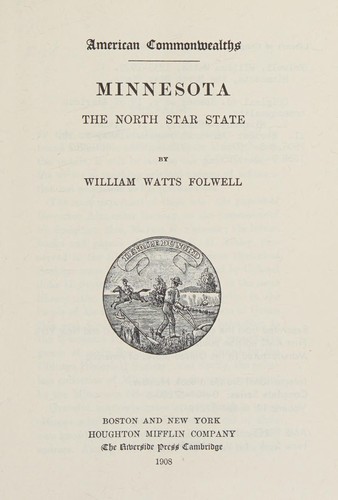
Minnesota, the North Star StateFolwell, William Watts
History
Minnesota, the North Star State
Folwell, William Watts
Minnesota -- History
legislature to which the recommendation was addressed nor any
subsequent one has been willing to propose to the people a revision of
the constitution. Casual amendments have been frequent, but a late
amendment to the amending article, requiring an affirmative vote of a
majority of all the electors to adopt a proposed amendment, will
certainly render it difficult, and it may be impossible, to make
further casual changes in the state’s organic law. A happy illustration
of Mr. Austin’s independence may be found in his action on the
disposition of the so-called “internal improvement lands” of the state.
An almost forgotten statute of the United States, passed in 1841,
authorized the gift to any new state of five hundred thousand acres of
public lands for “internal improvements.” The claim of Minnesota to
this grant had been tardily conceded by the Secretary of the Interior.
In his inaugural address Governor Austin recommended that the
disposition of the lands should be submitted to popular vote. The
legislature then opening (1870) was of a different mind, and listened
to suggestions that the end of the law would be served if the lands
should be bestowed on certain railroad corporations willing to accept
them. When the legislature of 1871 convened that proposition seemed
much in favor, and a bill to divide the whole grant, then possibly
worth ten millions of dollars, in eleven parcels among seven
corporations was passed in so summary a manner as to suggest a careful
rehearsal for the purely formal proceedings. The support of the bill
was so evenly derived from the two political parties that neither of
them could claim the greater credit for guarding the public interest.
The veto message of Governor Austin will long remain a landmark in the
political history of the state. In the plainest of English he told the
legislators that they had been either cajoled or bullied into passing a
measure they dared not submit to the people, that the minute parceling
of the lands would be ridiculously ineffective, that they had no power
to divide the lands, but only the proceeds thereof, and that they had
voted to divert the national gift from its intended object. From this
date there was no question of a reëlection, should he desire it. In the
following year an amendment providing that no disposition should be
made of those lands until after the ratification of any proposed
measure by vote of the electors was submitted and, at the election,
adopted. The use to which they were put ten years later will be related
in its place.
Public-domain text, read in full here on John Shaqi.
Reviews
Reviews
No reviews yet
Be the first to share your thoughts on this work.
Elsewhere in the archive
Join the Discussion
Join the discussion
Sign in to leave a comment or review.
Sign InorCreate an account