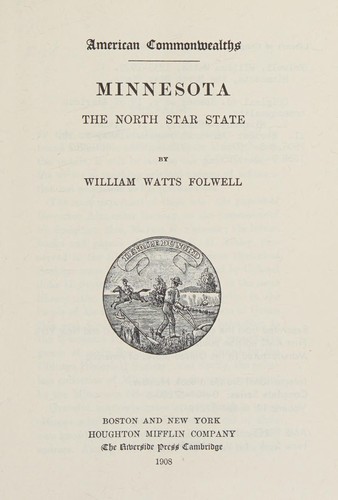
Minnesota, the North Star StateFolwell, William Watts
History
Minnesota, the North Star State
Folwell, William Watts
Minnesota -- History
In those years of plentiful money and multiplying fortunes, railroad
building was rapid and easy in Minnesota. Investors were keen for bonds
secured by land grants of enormous extent, and bearing a liberal
interest, especially when offered at a seductive discount. The
controlling spirits of the companies found some profit in financing
construction companies, but more in town lot and land speculations.
Railroad building out on the open prairie far in advance of settlement
was a novelty then. The gentlemen whose privilege it was to determine
the lines and locate the stations were in position to make profitable
selections of lots and lands, and to let their friends “in on the
ground floor” for a consideration. Around the selected stations
considerable villages would arise in a single season. In some cases the
town would be built before the track had reached it. There were
instances in which settlements were made on mistaken calculations of
actual location, and then the houses and shops were literally put on
wheels and hauled over to the chosen spots.
The lands adjacent to the railroad lines, especially within a few miles
of the stations, were, of course, in great demand and rose rapidly in
price. Cultivation was no longer confined to the river counties, but
spread rapidly inland. It did not take a generation of the hardest
labor to make a farm on the Minnesota prairie. In the first season the
newcomer could win his subsistence, and in the second begin to build.
The cultivated area of the state, which was 630,000 acres in the
closing year of the Civil War, rose to 1,863,300 in 1870, and five
years later fell not much short of 3,000,000.
A large fraction of this area was devoted to a kind of cultivation
novel to this country, but which remained profitable only so long as
the virgin fertility of the soil survived, and that was rarely longer
than ten years. “Bonanza farming,” so called, was carried on by large
proprietors or lessees, owning or controlling many thousands of acres,
employing machines and large gangs of men and animals. For these
estates there were developed out of the petty apparatus suitable to the
little eastern farm, the sulky plow with its two mould-boards, the disk
harrow, the twelve-foot seeder, the self-binding reaper, and the giant
threshing machine. There was but one principal crop, spring wheat,
which was commonly threshed from the shock and immediately marketed. To
handle the great quantities, grain “elevators” were built at the
railroad stations, tall, ungainly structures with conveniences for
weighing in, lifting, weighing out, and spouting into waiting freight
cars. At terminals were erected elevators for cleaning and drying
grain, as well as for storage for many thousands or millions of
bushels. The country elevator was also convenient for the small farmer,
who was saved the cost of building a granary of high-priced lumber from
distant pineries.
Public-domain text, read in full here on John Shaqi.
Reviews
Reviews
No reviews yet
Be the first to share your thoughts on this work.
Elsewhere in the archive
Join the Discussion
Join the discussion
Sign in to leave a comment or review.
Sign InorCreate an account