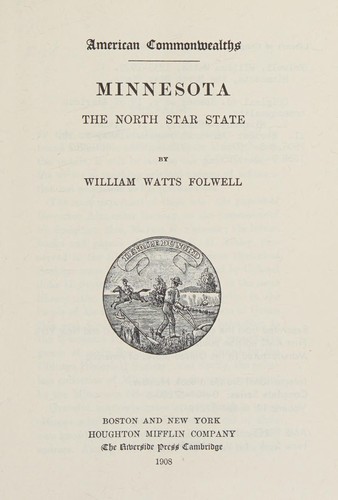
Minnesota, the North Star StateFolwell, William Watts
History
Minnesota, the North Star State
Folwell, William Watts
Minnesota -- History
For Minnesota as for the country at large, the early seventies belong
to one of the most notable “boom” periods in our economic history. The
census of 1870 verified the hopes of enthusiastic promoters in many
lines. The total population footed up 439,706. The native born in round
numbers were 279,000, of whom 126,000 had been born in the state. The
foreign born were 161,000, of whom the Scandinavian kingdoms had sent
59,000 and Germany 41,000. The English-speaking immigrants numbered
47,000. The swelling number of inhabitants was inspiring and the high
quality of the population was equally satisfactory. One hundred and
thirty-one thousand coming from the north Atlantic and north central
states had brought with them American traditions and culture, capital,
brains, and ambition for an enlarged career in a land of opportunity.
The foreign accessions were Christians, willing workers, and many of
them passionate lovers of free government.
The rapid extension of railroads was both a cause and a consequence of
this increase of people; of their distribution, their productive power,
and their demands for the comforts and luxuries of other skies. Rail
connection eastward by way of the head of Lake Michigan, established in
1867, had given quicker mails and shortened the passenger journey to
the seaboard. No produce save that of highest value in smallest bulk
could stand transportation charges to New York. The completion of the
railroad from St. Paul to the head of Lake Superior in 1870 brought
that city almost as near salt water as Chicago, and opened the great
waterway of the lakes for Minnesota’s grain and lumber, and returning
coal and merchandise. Later her annual millions of tons of iron ore
have passed down through “The Soo” to Lake Erie ports.
The year following (1871) was abundant in railroad extension. The main
line of the Great Northern was extended to Breckenridge on the Red
River of the North; the River division of the Chicago, Milwaukee and
St. Paul, prolonged to Winona, shortened the journey to Chicago by many
hours; and the Northern Pacific had reached the Red River at Moorhead.
Meantime the Southern Minnesota had been pushed out to the Blue Earth,
and the Winona and St. Peter to the Minnesota. The 350 miles built in
1872, though reaching no important terminals, brought the total mileage
at the close of the year up to an even 1900.
Public-domain text, read in full here on John Shaqi.
Reviews
Reviews
No reviews yet
Be the first to share your thoughts on this work.
Elsewhere in the archive
Join the Discussion
Join the discussion
Sign in to leave a comment or review.
Sign InorCreate an account