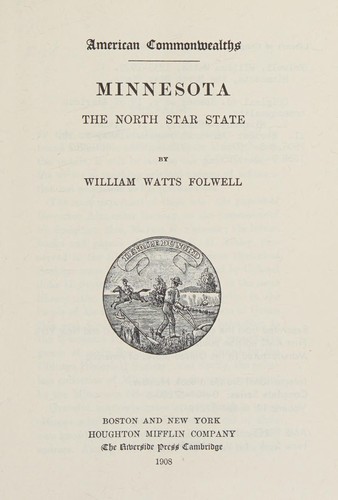
Minnesota, the North Star StateFolwell, William Watts
History
Minnesota, the North Star State
Folwell, William Watts
Minnesota -- History
The rapid development of a great milling centre at the Falls of St.
Anthony opened a market for the spring wheat, which could not otherwise
have been grown. The Minnesota crop of fifteen million of bushels in
1870 was to be doubled in 1875. The patent milling process gave to
Minneapolis an advantage soon apparent in the multiplication not only
of flour mills, but of industries ancillary thereto. The manufacture of
lumber out of logs from the pineries of the upper Mississippi and its
tributaries, which had been her leading industry, now took a second but
still important place. The city of Saint Anthony’s Falls had suffered
by the migration of many of her most capable men of affairs to “the
west side,” where Minneapolis sprang into being as by magic when the
military reservation was reduced in the middle of the fifties. The new
city soon outstripped the old in population, in manufacturing, and in
merchandizing. At length it became apparent that there was no propriety
in the maintenance of separate municipal organizations at the falls. By
virtue of an act of the legislature, approved February 28, 1872, the
older city lost its name and became the east division of Minneapolis.
The regrets of some of her oldest citizens were mitigated by the
suggestion that the Minneapolis thus enlarged might some day become the
rival of Minnesota’s capital city in wealth and numbers, if not in
political importance.
The land grant railroads, rapidly extended after the Civil War, had
occasioned the building of new towns, the opening of new farms, the
production of more millions of bushels of wheat, to be passed through
more elevators and carried in more freight cars to more mills, for
conversion into more thousands of barrels of Minnesota Patent flour.
All these called for more miles of railroad, and the revolving game
went merrily on for some years. So obvious were the advantages of
railroad transportation that every possible inducement was held out to
invite construction. Rights of way and bonuses in the shape of town,
county, and city bonds were willingly bestowed. State and municipal
authorities were so indulgent and generous that railroad “interests”
came to expect the fulfillment of any requisitions they should please
to make. A crowning example of this confidence has been given in the
so-called “land grab” of 1871, whose consummation lacked only the
approval of Governor Austin. But under this seeming of prosperity for
the public and the people whose wealth was going into the railroads
there was trouble brewing. Transportation did not come as cheap as the
public was expecting from corporations, which had received from
Congress public lands worth about $10,000 per mile at government
prices, to aid them in building. Five cents per mile passenger fare
seemed exorbitant, as did freight rates ranging from seven cents to
sixty cents per ton mile. The immense loans made by sale of bonds were
understood to be part of a policy of the corporation managers to get
Public-domain text, read in full here on John Shaqi.
Reviews
Reviews
No reviews yet
Be the first to share your thoughts on this work.
Elsewhere in the archive
Join the Discussion
Join the discussion
Sign in to leave a comment or review.
Sign InorCreate an account