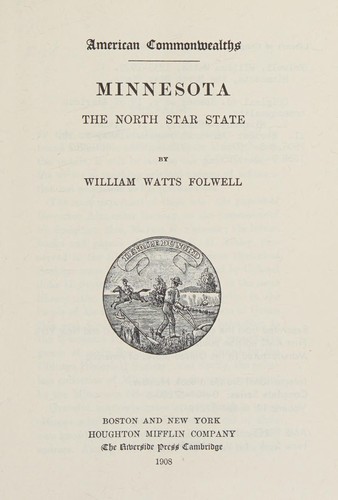
Minnesota, the North Star StateFolwell, William Watts
History
Minnesota, the North Star State
Folwell, William Watts
Minnesota -- History
their roads built on credit, and to hold the lands, released from the
primary mortgages, for speculation. There were abundant innuendoes
thrown out in political campaigns that public officials, especially
members of legislative bodies, national, state, and municipal, had not
been losers by the grants and indulgences showered on the corporations.
It is improbable that many individuals were thus persuaded or enriched
by large benefactions. When the whole community were ready to grant
everything a railroad company could ask, there was little need for
“graft.”
Chief, however, among all causes of exasperation were the frequent and
notorious discriminations in favor of some individuals, industries, and
places against others. By the connivance of one or more companies the
fuel supply of a city was put into the hands of a single firm or
clique. The big shipper generally was conceded a better rate than his
small competitors. But it must be said that at terminal points and
junctions, where shippers had the choice of two or more lines, they
sometimes forced the hungry traffic managers to offer rates by no means
agreeable or profitable. When the rate per hundred pounds on
merchandise from New York by way of the lakes to St. Paul, including
156 miles of railroad haul, was 35 cents, that from St. Paul to
Faribault, 56 miles, was 39 cents. The state constitution contained
(and still contains) the provision that all common carriers enjoying
right of way for public use shall carry the mineral, agricultural, and
other productions of the state “on equal and reasonable terms.” The
farmers could not see that a rate on wheat from Owatonna to Winona of
2.6 cents, and one of 6 cents from Rochester, 40 miles on the road
nearer Winona, were “equal”; nor could the people of Faribault and
vicinity see what justice there was in paying $29.50 freight per
carload of lumber from the falls, while residents of Owatonna, 15 miles
farther on, should enjoy a rate of $18.
As early as 1866, in his inaugural address to the legislature, Governor
Marshall had advised that body to be looking out “for the interests of
the people against possible oppression from these corporations, which
will soon be a power in the land.” In his message of 1867 he suggested
that it was time to attach proper terms and conditions to railroad aid.
He did not like the withdrawal of ten million acres of land from the
operation of the homestead act.
Public-domain text, read in full here on John Shaqi.
Reviews
Reviews
No reviews yet
Be the first to share your thoughts on this work.
Elsewhere in the archive
Join the Discussion
Join the discussion
Sign in to leave a comment or review.
Sign InorCreate an account