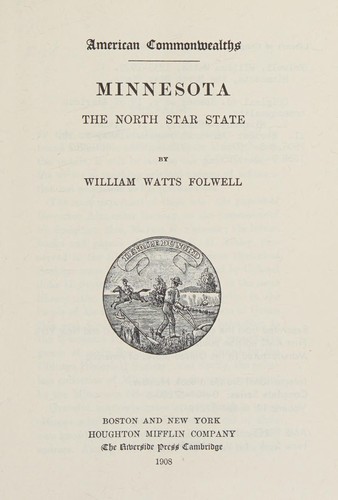
Minnesota, the North Star StateFolwell, William Watts
History
Minnesota, the North Star State
Folwell, William Watts
Minnesota -- History
Still it was a Democratic House, willing, according to abundant
precedent, to seat its partisan contestant if any plausible explanation
could be invented. On the last day of the session two reports came in
from the committee on elections, each signed by five members. The
committee had arrived at no conclusion. The House ordered the reports
printed and recommitted, and that was the last ever heard of the
contest. Mr. Washburn served out the term with great satisfaction to
his constituents, and was accorded two reëlections by majorities which
nobody had occasion to question.
Ignatius Donnelly thus closed his career in national politics. He
appeared later in two or more state legislatures, and was editor of
several short-lived weekly newspapers. In early life he had published a
small volume of poems and some prose essays in which he gave assurance
of literary ability. His occupation as statesman gone, he now turned to
authorship. In the winter of 1880-81 he composed a geographical
romance, entitled “Atlantis, the Lost Continent.” He dressed the
ancient classical legend in such attractive garb as to interest a great
body of readers, serious and other. Many editions have been published.
This work was followed by another, similar in character, under the
title of “Ragnarök.” The author elaborated the ingenious theory that
the mantle of drift covering large portions of the northern hemisphere
had been landed where it lies, when the earth at some time crossed the
orbit of some great meteor. This fascinating book was also widely read.
Mr. Donnelly next took up the study of a question which had already
been among his recreations, that of the authorship of the plays and
poems of Shakespeare. His “Great Cryptogram” of a thousand octavo pages
contains the results of “an incalculable labor, reaching through many
weary years.” In the first part of King Henry the Fourth, Mr. Donnelly
professed to have discovered the key to an involved cipher showing that
Francis Bacon, Nicholas Bacon’s son, had a mysterious connection with
that work, although making no clear and direct claim to its authorship.
There was a bewildering array of “root numbers” and “modifying
numbers,” beyond the understanding of the wayfaring man. No hidden
secrets were revealed by the ingenious and complicated computations,
and no additions to historical knowledge were obtained. But Mr.
Donnelly only claimed to have made a small beginning of a great work
left to future investigators. The book, however, excited great interest
among people concerned with the Bacon-Shakespeare controversy, and
formed a notable addition to that literature. In 1889 the indefatigable
author brought out a novel under the title “Cæsar’s Column,” being a
graphic and horrible picture of the fancied results of the sway of an
unbridled plutocracy in America. Published at a happy moment, the book
was sold by hundreds of thousands of copies, not only in America but in
translated versions in Europe.
Public-domain text, read in full here on John Shaqi.
Reviews
Reviews
No reviews yet
Be the first to share your thoughts on this work.
Elsewhere in the archive
Join the Discussion
Join the discussion
Sign in to leave a comment or review.
Sign InorCreate an account