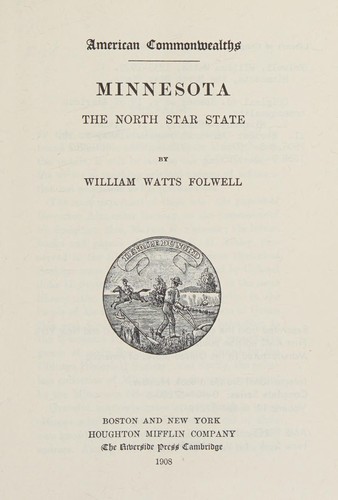
Minnesota, the North Star StateFolwell, William Watts
History
Minnesota, the North Star State
Folwell, William Watts
Minnesota -- History
The first edition appeared under the
name of Edmund Boisgilbert, and the author had no little difficulty in
finding a publisher. In another novel, “Dr. Huguet,” the author
appealed for a humaner treatment of people of color, but the public did
not respond by buying largely. Later ephemeral volumes and pamphlets
added nothing to the repute of a Minnesota author known wherever the
English tongue was spoken.
* * * * *
The superintendent of public instruction during the Pillsbury
administrations was the Rev. David Burt. Although his education was
clerical and his educational experience brief, by a conscientious
devotion to the novel duties he carried forward successfully the work
of his predecessors. He did much to annul the chronic opposition to the
normal schools, and justified the regents of the university in asking
more liberal appropriations for buildings and appliances, in spite of
the small numbers of its early graduating classes. He persuaded the
legislature with no little persistence that the common school fund
should be distributed to the districts according to the number of
children attending, and not according to the census of those of school
age.
The legislature of 1877, acting under an amendment to the constitution
adopted two years before, extended to women the right to vote on all
measures relating to schools, including the choice of school officers;
and “to hold any office pertaining solely to the management of
schools.” A later constitutional change extended this privilege to
library officers and measures. It has been effectively exercised in but
few instances.
In his annual message for 1874 Governor Austin advised the legislature
that the text-books used in the common schools were sold to parents at
exorbitant prices fixed by a convention of the publishing craft, but
made no definite suggestion for relief. Ignatius Donnelly, who was in
the state senate continuously from 1874 to 1878, took the lead in an
effort to emancipate the people from the tyranny of the school-book
ring. His favorite plan was to have the state print books prepared by
competent experts and distribute them free to the schools. Two bills
for this purpose were passed by the senate and defeated in the house.
In 1877 a well-known book dealer of St. Paul came forward with a
proposition to furnish text-books as good as those in use for half the
prices exacted, provided he could have a fifteen-year contract. To this
the legislature agreed, and the contract was made and executed. Mr.
Donnelly’s biographer claims that the saving to the state in that term
was at least $2,839,765. There is no positive evidence of the
allegations that large amounts of money were used to defeat the bill.
Public-domain text, read in full here on John Shaqi.
Reviews
Reviews
No reviews yet
Be the first to share your thoughts on this work.
Elsewhere in the archive
Join the Discussion
Join the discussion
Sign in to leave a comment or review.
Sign InorCreate an account