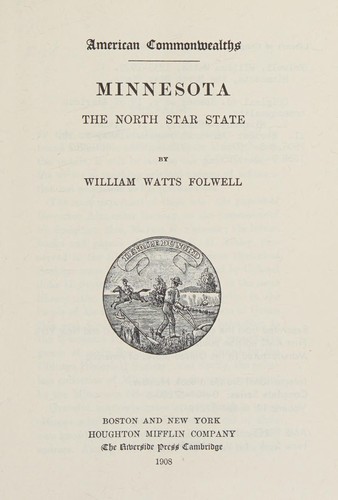
Minnesota, the North Star StateFolwell, William Watts
History
Minnesota, the North Star State
Folwell, William Watts
Minnesota -- History
equitable a compromise.” The legislature of 1871 entertained a new
proposition. The bill introduced provided for a commission whose first
duty should be to ascertain and decide whether the bonds were a legal
and equitable obligation against the state. If the decision should be
affirmative, the commission was to award to each holder the amount due
him on the basis of cost, and deliver to him proper amount of new state
bonds. The railroad taxes were to be devoted to the redemption of the
new bonds. General Sibley had left his retirement and taken a seat in
the house of representatives because of his desire to see the old bond
matter settled. He had never wavered from his opinion that the state
was a debtor to the full amount of the bonds issued. But for his
influence the bill could not have passed. He would not believe that
Minnesota would not at some time pay what she had promised to pay.
Could he so believe, he declared in his speech, he would emigrate to
some community in which he would not suffer the “intolerable
humiliation” of living in a “repudiating state frowned on by a just and
righteous God and abhorred by man.” Governor Austin, although he
sympathized with the popular feeling, did not disapprove the bill, but
let it go to be mercilessly slaughtered at the polls. The people would
not pay mere paper obligations without right or equity behind them.
Such they held the bonds to be.
Having failed to obtain satisfaction from the political authorities,
the claimants presently resorted to the courts. In 1873 Mr.
Chamberlain, their representative, sued the St. Paul and Sioux City
Railroad Company to recover from that company as assignee of a portion
of the land grant, which he claimed to be still subject to the
mortgages authorized by the “five million loan bill.” The decision went
against him in the Circuit Court of the United States, and he took an
appeal to the Supreme Court, to be there finally defeated. Both of
these courts, however, took opportunity to declare that the bonds were
legal obligations, and that if the state of Minnesota were suable no
court of justice could refuse to adjudge her to pay. “Justice and honor
alike” bound her to redeem her bonds. The state of Minnesota was thus
branded by the highest judicial tribunals of the land as a defaulting,
repudiating state, regardless of the claims of honor and justice. These
opinions—they were not decrees—had little effect on the Minnesota
people, most of whom never heard of them, but they did affect the minds
of many of her public men, who smarted under the reproaches they could
not help but hear. Governor Davis in his retiring message urged the
establishment of a commission to arbitrate between the bondholders and
the state. Governor Pillsbury in his inaugural address urged the
payment of the bonds in full, to redeem the reputation of the state. To
these appeals the legislators gave no heed. To the legislature of 1877
Mr.
Public-domain text, read in full here on John Shaqi.
Reviews
Reviews
No reviews yet
Be the first to share your thoughts on this work.
Elsewhere in the archive
Join the Discussion
Join the discussion
Sign in to leave a comment or review.
Sign InorCreate an account