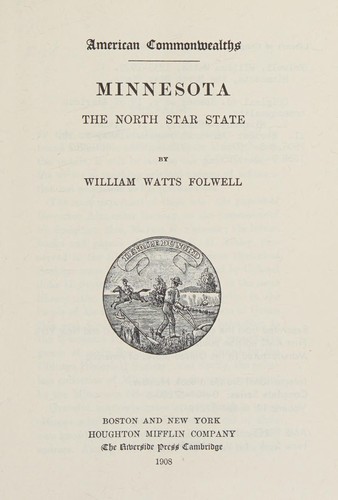
Minnesota, the North Star StateFolwell, William Watts
History
Minnesota, the North Star State
Folwell, William Watts
Minnesota -- History
It had been the policy of the state to intrust the care of her penal
and charitable institutions to separate boards of citizens serving
without pay. To secure uniformity of administration and to enable these
separate bodies to profit from one another’s experiences, a state board
of charities and corrections was authorized by law in 1883. To the
working secretary of this board for fourteen years, Mr. Henry H. Hart,
must be accorded high praise for such unstinted and intelligent
devotion to his duties that Minnesota’s institutions of charities and
corrections were accorded a place in the front rank. The state lost one
of her most valuable servants by his deserved promotion beyond her
borders.
Following Governor Hubbard’s earnest advice, the legislature of 1885
established “The State Public School” for neglected children, which
under wise management by different officials has rescued from lives of
crime or dependence many hundreds of homeless waifs. The reformatory
for youthful delinquents and the Soldiers’ Home, commended by him to
the legislature, were established under the succeeding administration.
His repeated recommendation that all moneys coming into county
treasuries should be “covered in” through the county auditor’s office
fell on deaf ears, and that needed reform in our public accounting
still remains to be wrought.
The sanction of the granger laws by the Supreme Court of the United
States had established the principle that states have the
constitutional right to regulate railroads; but Minnesota had not
exercised the right in any vigorous or comprehensive way, partly
because the companies had of their own motion moderated charges,
improved their administration, and shown a disposition to treat the
public with some respect. Still, complaints of extortion, unjust
discrimination, and insolence were frequent, and by many believed to
be well founded. Governor Hubbard in his first two messages urged the
legislatures to take up these complaints and endeavor to frame a
comprehensive statute which should secure to the companies their just
rights and immunities, and at the same time protect the people in
theirs. The result was the railroad law of 1885, chapter 188 of the
session laws of that year. This act, judiciously drawn, met the
purpose of its framers so fully that amendment has been necessary
only in points of detail. The historian at some far-off day will
marvel that in the closing years of the nineteenth century it was
necessary to compel common carriers by law not merely to serve the
public at just and equal charges published in advance, but to provide
common decencies and accommodations in the way of platforms,
waiting-rooms, fire-extinguishers, and toilet-rooms.
Public-domain text, read in full here on John Shaqi.
Reviews
Reviews
No reviews yet
Be the first to share your thoughts on this work.
Elsewhere in the archive
Join the Discussion
Join the discussion
Sign in to leave a comment or review.
Sign InorCreate an account