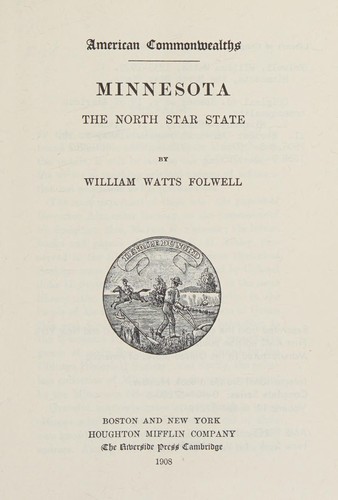
Minnesota, the North Star StateFolwell, William Watts
History
Minnesota, the North Star State
Folwell, William Watts
Minnesota -- History
the old bond controversy quieted. The state’s power to borrow at
reasonable interest had never been affected. Good judges were of
opinion that the bondholders fared very well and could afford the
liberal expenditures made to secure the legislation. The amount of new
bonds issued was $4,253,000, of which Mr. S. Chamberlain received
$1,992,053.70. Governor Pillsbury closed his third term by signing
them, a duty he performed with great satisfaction. With this he retired
from office, except that he served on the board of regents of the
university till his death in 1902, the legislature having by special
act created him an additional regent during his good pleasure. He had
been on that board since 1863.
CHAPTER XVIII
FAIR WEATHER
Whether Governor Pillsbury could have been nominated for a fourth term
may be questioned, but when he publicly declined a fortnight before the
Republican convention, it was evident that among the aspirants to the
succession the favorite was the gallant colonel of the Fifth Minnesota,
General Lucius F. Hubbard. The nomination was his on the first ballot.
He brought to the office a ripe experience in legislation and public
affairs and a worthy ambition to promote the public welfare. He was
easily accorded a reëlection in 1882, and, by reason of a change made
in the official year of the state, remained in office a fifth year. It
was a period of marked prosperity, not greatly diminished by the
commercial depression of 1883-84. The population of the state rose from
780,773 in 1880 to 1,117,798 in 1885, an increase of forty-three per
cent. The urban communities had an excessive increase of nearly eighty
per cent.; Minneapolis increased from 46,887 to 129,200. Twelve hundred
and sixty-nine miles of railroad were added.
Governor Hubbard’s interest in organizations and institutions for
promoting the public health, improving the administration of the penal
and charitable institutions, and the relief of superannuated soldiers
was deep and continuous. With his hearty approval the legislature of
1883 enlarged the powers of the state board of health, which had been
in existence for ten years with powers and resources much too limited.
The executive secretary of the board for nearly the first quarter
century was Dr. Charles N. Hewitt, whose conception of the state’s
interest and duty in preserving the health and increasing the physical
efficiency of its members was in advance of his time.
Public-domain text, read in full here on John Shaqi.
Reviews
Reviews
No reviews yet
Be the first to share your thoughts on this work.
Elsewhere in the archive
Join the Discussion
Join the discussion
Sign in to leave a comment or review.
Sign InorCreate an account