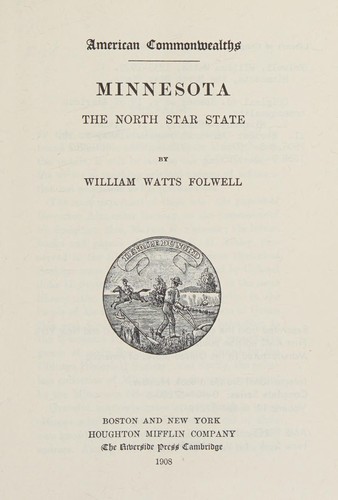
Minnesota, the North Star StateFolwell, William Watts
History
Minnesota, the North Star State
Folwell, William Watts
Minnesota -- History
The legislature of 1899 passed a law providing for “primary elections”
to replace nominations by party caucuses and conventions. The act is
not operative in towns, villages, and small cities, and does not apply
to state officers. The primary election takes place on the first of the
registration days for the usual election, and is conducted by the same
judges and clerks. Any person eligible to an office may, by payment of
a prescribed fee and making a qualifying oath, have his name printed on
the primary ballot of his party. Every qualified voter may, after
registration, receive and mark the ballot of the party he “generally
supported at the last election and intends to support at the next
ensuing.” The general election laws apply, and the usual penalties
attach to misconduct. The experiment is still too brief to warrant a
final judgment. It has certainly weakened the machine, and stimulated
aspiration to office in persons whose qualifications are more apparent
to themselves than to others. That candidates for judicial positions
are obliged to make a personal canvass is perhaps the feature most to
be regretted.
When the capitol building was burned in 1881 the legislature, upon
Governor Pillsbury’s recommendation, immediately appropriated $75,000
for rebuilding, on the assumption that the walls were sufficiently
sound. This assumption was found mistaken, and additional sums were
voted till more than four times the original amount was expended. But
ten years had not passed before it was apparent that ampler
accommodations were imperative for multiplying functionaries and
expanding business. The legislature of 1893 accordingly authorized the
appointment of a commission to plan, build, and furnish a new and
appropriate structure. The local influence was sufficiently effective
to keep the location in the heart of St. Paul, on an elevated site of
small area, rather than permit erection on a larger area in the “midway
district,” still in that city, but near Minneapolis. The corner-stone
was laid on July 27, 1898, by Alexander Ramsey. Senator C. K. Davis
delivered the principal address. The legislature of 1905 was the first
to convene in the completed building. The traditional plan of a central
body flanked by wings and surmounted by a dome was followed, with the
variation that the house of representatives is housed in a rear
extension, leaving the wings to accommodate the senate and the supreme
court. The exterior is of Georgia marble. The interior corridors are
faced with polished Minnesota magnesian limestones of charming tints,
relieved by panels of foreign marbles. The interior of the dome, the
senate chamber, the supreme court room, and the governor’s office are
splendidly decorated with mural paintings by leading American artists.
Over the façade of the central structure rests a quadriga in bronze,
typifying the progress of Minnesota. The total cost was $4,428,539.72;
and in this age the honorable commissioners need not resent as
Public-domain text, read in full here on John Shaqi.
Reviews
Reviews
No reviews yet
Be the first to share your thoughts on this work.
Elsewhere in the archive
Join the Discussion
Join the discussion
Sign in to leave a comment or review.
Sign InorCreate an account