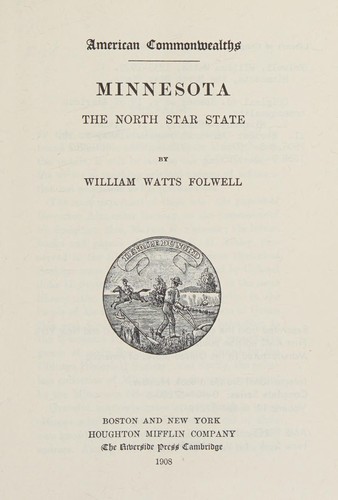
Minnesota, the North Star StateFolwell, William Watts
History
Minnesota, the North Star State
Folwell, William Watts
Minnesota -- History
superfluous the record that there was absolutely no “graft” in the
whole construction and furnishing. The architect, Mr. Cass Gilbert, a
native of Minnesota, will be fortunate if he shall in his future career
surpass the taste, skill, and nobility of conception displayed in this
work. It is a splendid object lesson in civic architecture, not only to
Minnesota but to neighboring commonwealths.
The legislature of 1905 adopted a new codification of the general laws
of the state, which had been prepared by a commission of which Daniel
Fish, Esq., was the working member. It has been published in a single
volume of 1380 pages.
The penal and charitable institutions of Minnesota under the
supervision of the board of charities and corrections had attained to
the first rank for economy of administration and beneficial results.
Two neighboring states made the experiment of disbanding the separate
boards of trustees or managers and placing all such institutions in the
hands of a single “board of control.” To be in the fashion the
legislature of Minnesota in 1901 created a board of control of state
institutions, and went so far as to include the university and normal
schools in all their financial concerns. These, however, were in a
later year exempted from the operation of the act and restored to their
independence. It may be conceded that in point of finance the single
board has justified the change, in spite of the fact that its members
have been appointed on political considerations. Persuaded that there
was danger of neglect in a board so composed and fully occupied with
the business management of the institutions, the legislature of 1907
provided for a board of visitors to exercise a humanitarian supervision
over the patients and inmates.
The people of Minnesota have not yet desired a revision of their
constitution, content to live under the original statute of 1857 and to
amend it casually from time to time. In the period now in view no fewer
than seventeen amendments have been adopted, some of them of
far-reaching importance. They may be enumerated:—
1. 1883, an amendment fixing January 1 as the beginning of the
official year of the state, on which day all officers chosen at
the previous election enter upon their duties.
2. 1886, an amendment authorizing loans upon interest from the
permanent school fund of the state to counties and school
districts, to be used in the erection of county and school
buildings. This provision, wisely guarded, has proved
advantageous.
3. Of the same year, an amendment forbidding the enactment of any
special law in all cases where a general law can be made
applicable, and specifically inhibiting special legislation in
fifteen cases. Its operation has been beneficial, but there have
been instances where special legislation has been had under mere
color of general.
Public-domain text, read in full here on John Shaqi.
Reviews
Reviews
No reviews yet
Be the first to share your thoughts on this work.
Elsewhere in the archive
Join the Discussion
Join the discussion
Sign in to leave a comment or review.
Sign InorCreate an account