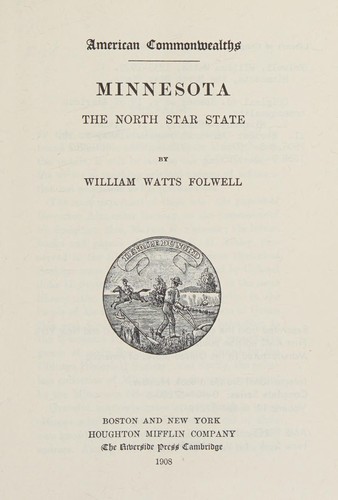
Minnesota, the North Star StateFolwell, William Watts
History
Minnesota, the North Star State
Folwell, William Watts
Minnesota -- History
4. 1888, an amendment limiting the sessions of the legislature to
ninety legislative days, and forbidding the introduction of any
new bill during the last twenty days, unless upon recommendation
of the governor in a special message.
5. Of the same year, an amendment declaring any combination to
monopolize markets for food products, or to interfere with the
freedom of such markets, to be a criminal conspiracy, punishable
as the legislature may provide. No action has yet been had.
6. 1890, an amendment authorizing the legislature to provide that an
agreement of ten jurors in a civil action shall be a sufficient
verdict. The legislature has not yet acted.
7. 1896, an amendment creating a board of pardons, consisting of the
governor, the attorney-general, and the chief justice, with
powers to be defined and regulated by law. The procedure of the
board has been prescribed by statute. Its administration has been
judicious, and the governor has been relieved of a duty
exceedingly painful and difficult for any individual to
discharge.
8. 1896, an amendment to the elective franchise article, taking from
declarants for naturalization the right to vote.
9. In the year 1906 a so-called “wide open” tax amendment, repealing
a large part of Article IX as formerly standing. It declares that
“the power of taxation shall never be surrendered, suspended, nor
contracted away.” After exemptions of the ordinary kind, it
leaves the legislature free to levy taxes according to its
discretion, requiring only that they shall be uniform upon the
same class of subjects.
10. 1898, an amendment granting suffrage to women of full age in
school and library measures absolutely, and not merely allowing
the legislature to extend the privilege.
11. In the same year, an amendment requiring a majority of all votes
cast at the election to ratify an amendment to the constitution.
Up to that year a majority of the electors voting on the
particular amendment was sufficient to ratify.
12. In the same year, an amendment creating a state highway
commission and a road and bridge fund and authorizing a special
tax therefor.
13. Also in 1898, an amendment authorizing cities and villages to
adopt charters for their own government, to be drafted by a board
of freeholders appointed by district judges; commonly called a
“home-rule” amendment. An affirmative vote of four sevenths of
the electors is necessary to adopt. In Minneapolis on four
occasions, large majorities have favored “home rule,” but the
required four-sevenths vote has not been obtained.
Public-domain text, read in full here on John Shaqi.
Reviews
Reviews
No reviews yet
Be the first to share your thoughts on this work.
Elsewhere in the archive
Join the Discussion
Join the discussion
Sign in to leave a comment or review.
Sign InorCreate an account