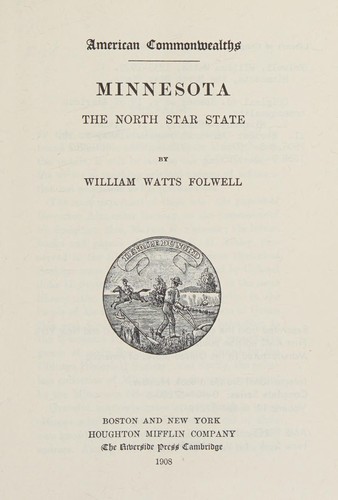
Minnesota, the North Star StateFolwell, William Watts
History
Minnesota, the North Star State
Folwell, William Watts
Minnesota -- History
One department of the school of agriculture of the university has had
no small part in working a great change in Minnesota agriculture. While
the state as a whole will long retain a leading place as a wheat
producer, all southern Minnesota has abandoned that cereal as a
principal crop. Supplied from the department of dairy husbandry of the
school of agriculture with expert operators of creameries and cheese
factories, the farmers of many counties have turned to dairying.
Minnesota butter, thanks to the science and practice taught in the
school, commands a premium in the market, and its annual output has run
up to near 100,000,000 pounds. Minnesota has become the “Bread and
Butter State.” The total dairy product of Minnesota in 1907 may be
safely valued at $40,000,000. Along with dairying has naturally grown
up an extensive animal husbandry, profitably converting into marketable
forms the forage crops of great areas.
At the experiment station conducted in the agricultural department of
the university new varieties of grains, in particular wheat, have been
developed by careful breeding and selection, which promise much to
Minnesota farmers.
Adjoining the agricultural establishment of the university is the
domain of two hundred acres and more on which the Minnesota State
Agricultural Society, in a vast range of buildings and inclosures,
holds its annual fair in September. Given this permanent location in
1885, the society has developed a great industrial museum of high
educational value.
* * * * *
For many years after the white man built his sawmills on Minnesota
rivers it was believed that the pine forests north and east of the
Sioux-Chippeway intertribal boundary of 1825 could never be exhausted.
A generation ago that belief was given up, but exhaustion was thought
to be so far away that people then living need not worry about it.
There being no public control over private lumbering, the reckless,
indiscriminate, ruinous methods of the pioneer operators were
continued. Young growing trees went down along with those old and ripe
for the axe. Within a few years it has become apparent to all who
concern themselves, that the days of Minnesota lumbering in the old
piratical fashion are numbered. Had a reasonable forest policy been
established fifty years ago, permitting only the annual cutting of ripe
trees and leaving the young to grow, a harvest of lumber might have
been reaped in perpetuity. There are millions of acres of land in the
state which are fit only for forest growth and will some day be so
devoted. An act of the legislature of 1899 created a state forestry
board, which has already outlined a policy and begun the immense work
of re-afforesting despoiled areas. Another act, that of 1905, provides
for a forest commissioner, and to that office has been appointed
General C. C. Andrews, who for many years has been the apostle of
forest preservation and replanting in Minnesota.
Public-domain text, read in full here on John Shaqi.
Reviews
Reviews
No reviews yet
Be the first to share your thoughts on this work.
Elsewhere in the archive
Join the Discussion
Join the discussion
Sign in to leave a comment or review.
Sign InorCreate an account