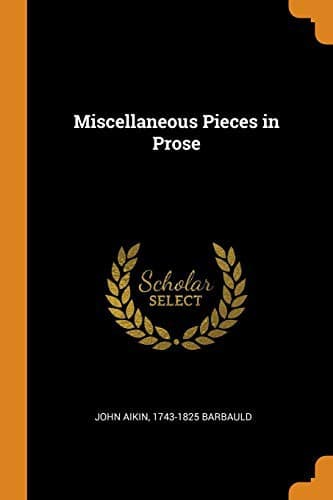
Miscellaneous Pieces, in ProseBarbauld, Mrs. (Anna Letitia)
General
Miscellaneous Pieces, in Prose
Barbauld, Mrs. (Anna Letitia)
English prose literature -- 18th century
Transcriber’s Note
In this text version of “Miscellaneous Pieces, in Prose”, words in
italics are marked with _underscores_, words in small capitals are
shown in UPPER CASE.
Footnotes have been moved the end of paragraphs.
Variant spelling and irregular punctuation are retained.
The changes that have been made are listed at the end of the book.
MISCELLANEOUS PIECES,
IN
PROSE,
BY
JOHN AIKIN, M. D.
AND
ANNA LÆTITIA BARBAULD.
THE THIRD EDITION.
LONDON:
PRINTED FOR J. JOHNSON, IN ST. PAUL’S CHURCH-YARD,
M.DCC.XCII.
CONTENTS.
Page
_On the Province of Comedy_ 1
_The Hill of Science, a Vision_ 27
_On Romances, an Imitation_ 39
_Seláma, an Imitation of Ossian_ 47
_Against Inconsistency in our Expectations_ 59
_The Canal and the Brook, an Apologue_ 79
_On Monastic Institutions_ 88
_On the Pleasure derived from Objects of Terror;
with Sir Bertrand, a Fragment_ 119
_On the Heroic Poem of Gondibert_ 138
_An Enquiry into those Kinds of Distress which
excite agreeable Sensations; with a Tale_ 190
_Essay on Devotional Taste_ 220
ON THE PROVINCE OF COMEDY.
Various are the methods which art and ingenuity have invented to
exhibit a picture of human life and manners. These have differed from
each other, both in the mode of representation, and in the particular
view of the subject which has been taken. With respect to the first,
it is universally allowed that the dramatic form is by far the most
perfect. The circumstance of leaving every character to display itself
in its own proper language, with all the variations of tone and gesture
which distinguish it from others, and which mark every emotion of the
mind; and the scenic delusions of dress, painting, and machinery,
contribute to stamp such an appearance of reality upon dramatic
representations as no other of the imitative arts can attain. Indeed,
when in their perfection, they can scarcely be called imitations, but
the very things themselves; and real nature would perhaps appear less
perfect than her counterfeit.
The Drama has from early antiquity been distinguished into the two
grand divisions of Tragedy and Comedy. It would seem that the general
character of these was universally understood and agreed on, by the
adoption of the terms _tragic_ and _comic_, derived from them, into
the language of every civilized people. The former of these is, we
know, constantly applied to objects of terror and distress; the
latter, to those of mirth and pleasantry. There is, however, a more
comprehensive distinction of our feelings, which it is proper first to
consider.
Public-domain text, read in full here on John Shaqi.
Reviews
Reviews
No reviews yet
Be the first to share your thoughts on this work.
Join the Discussion
Join the discussion
Sign in to leave a comment or review.
Sign InorCreate an account