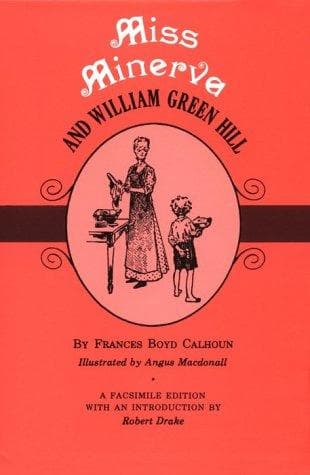
Miss Minerva and William Green HillCalhoun, Frances Boyd
General
Miss Minerva and William Green Hill
Calhoun, Frances Boyd
Aunts -- Fiction; Southern States -- Fiction
“Did you ever eat any bobbycued rabbit?” he asked. “Me an' Wilkes Booth
Lincoln been eatin' chit'lins, an' sweet 'taters, an' 'possum, an'
squirrel, an' hoecake, an' Brunswick stew ever sence we's born,” was his
proud announcement.
“Use your napkin,” commanded she, “and don't fill your mouth so full.”
The little boy flooded his plate with syrup.
“These-here 'lasses sho' is--” he began, but instantly remembering that
he must be more particular in his speech, he stammered out:
“These-here sho' is--am--are a nice messer 'lasses. I ain't never eat
sech a good bait. They sho' is--I aimed to say--these 'lasses sho' are a
bird; they's 'nother sight tastier 'n sorghum, an' Aunt Cindy 'lows that
sorghum is the very penurity of a nigger.”
She did not again correct him.
“I must be very patient,” she thought, “and go very slowly. I must not
expect too much of him at first.”
After breakfast Miss Minerva, who would not keep a servant, preferring
to do her own work, tied a big cook-apron around the little boy's neck,
and told him to churn while she washed the dishes. This arrangement did
not suit Billy.
“Boys don't churn,” he said sullenly, “me an' Wilkes Booth Lincoln don'
never have to churn sence we's born; 'omans has to churn an' I ain't
agoing to. Major Minerva--he ain't never churn,” he began belligerently
but his relative turned an uncompromising and rather perturbed back upon
him. Realizing that he was beaten, he submitted to his fate, clutched
the dasher angrily, and began his weary work.
He was glad his little black friend did not witness his disgrace.
As he thought of Wilkes Booth Lincoln the big tears came into his eyes
and rolled down his cheeks; he leaned way over the churn and the great
glistening tears splashed right into the hole made for the dasher, and
rolled into the milk.
Billy grew interested at once and laughed aloud; he puckered up his
face and tried to weep again, for he wanted more tears to fall into the
churn; but the tears refused to come and he couldn't squeeze another one
out of his eyes.
“Aunt Minerva,” he said mischievously, “I done ruint yo' buttermilk.”
“What have you done?” she inquired.
“It's done ruint,” he replied, “you'll hafter th'ow it away; 't ain't
fitten fer nothin.' I done cried 'bout a bucketful in it.”
“Why did you cry?” asked Miss Minerva calmly. “Don't you like to work?”
“Yes 'm, I jes' loves to work; I wish I had time to work all the time.
But it makes my belly ache to churn,--I got a awful pain right now.”
“Churn on!” she commanded unsympathetically.
He grabbed the dasher and churned vigorously for one minute.
“I reckon the butter's done come,” he announced, resting from his
labors.
“It hasn't begun to come yet,” replied the exasperated woman. “Don't
waste so much time, William.”
The child churned in silence for the space of two minutes, and
suggested: “It's time to put hot water in it; Aunt Cindy always puts hot
water in it. Lemme git some fer you.”
Public-domain text, read in full here on John Shaqi.
Reviews
Reviews
No reviews yet
Be the first to share your thoughts on this work.
Join the Discussion
Join the discussion
Sign in to leave a comment or review.
Sign InorCreate an account