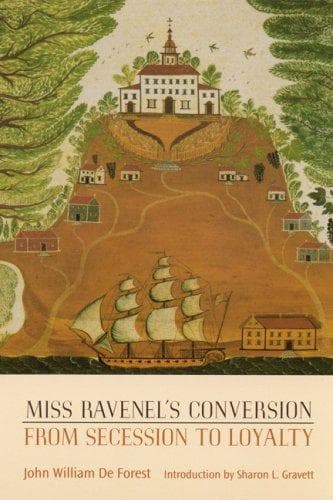
Miss Ravenel's conversion from secession to loyaltyDe Forest, John William
History
Miss Ravenel's conversion from secession to loyalty
De Forest, John William
Historical fiction; United States -- History -- Civil War, 1861-1865 -- Fiction; War stories; Women -- United States -- Fiction
Although she talked so strongly she did not seem more than half in
earnest. A half smile lurked around her lips of deep rose-color, and her
bright, almond-shaped black eyes sparkled with interest rather than with
passion. By the way, she was not a venerable personage, and not properly
Lillie's aunt, but only the widow of the late Mrs. Ravenel's brother,
not more than thirty-three years of age and still decidedly pretty. Her
complexion was dark, pale and a little too thick, but it was relieved by
the jet black of her regular eye-brows and of her masses of wavy hair.
Her face was oval, her nose, straight, her lips thin but nicely modeled,
her chin little and dimpled; her expression was generally gay and
coquettish, but amazingly variable and capable of running through a vast
gamut of sentiments, including affection, melancholy and piety. Though
short she was well built, with a deep, healthy chest, splendid arms and
finely turned ankles. She did not strike a careless observer as
handsome, but she bore close examination with advantage. The Doctor
instinctively suspected her; did not think her a safe woman to have
about, although he could allege no overtly wicked act against her; and
had brought up Lillie to be shy of her society. Nevertheless it was
impossible just now to keep her at a distance, for he would probably be
much away from home, and it was necessary to leave his daughter with
some one.
In politics, if not in other things, Mrs. Larue was as double-faced as
Janus. To undoubted secessionists she talked bitterly, coarsely,
scandalously against the northerners. If advisable she could go on about
Picayune Butler, Beast Butler, Traitor Farragut, Vandal Yankees,
wooden-nutmeg heroes, mudsills, nasty tinkers, nigger-worshippers,
amalgamationists, &c. &c. from nine o'clock in the morning when she got
up, till midnight when she went to bed. At the same time she could call
in a quiet way on the mayor or the commanding General to wheedle
protection out of them by playing her fine eyes and smiling and
flattering. Knowing the bad social repute of the Ravenels as Unionists,
she would not invite them into her own roomy house; but she was pleased
to have them in their own dwelling next door, because they might at a
pinch serve her as friends at the Butler court. On the principle of
justice to Satan, I must say that she was no fair sample of the proud
and stiff-necked slaveholding aristocracy of Louisiana. Neither was she
one of the patriotic and puritan few who shared the Doctor's sympathies
and principles. As she came of an old French Creole family, and her
husband had been a lawyer of note and an ultra southern politician, she
belonged, like the Ravenels, to the patrician order of New Orleans, only
that she was counted among the Soulé set, while her relatives had gone
over to the Barker faction. She had not been reduced to beggary by the
advent of the Yankees; her estate was not in the now worthless
Public-domain text, read in full here on John Shaqi.
Reviews
Reviews
No reviews yet
Be the first to share your thoughts on this work.
Elsewhere in the archive
Join the Discussion
Join the discussion
Sign in to leave a comment or review.
Sign InorCreate an account