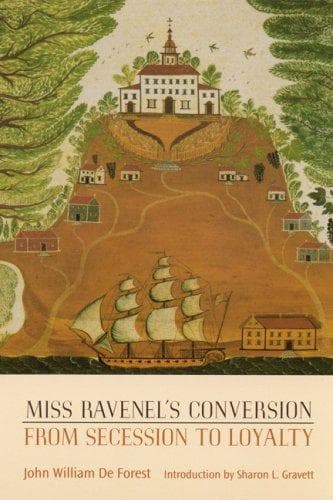
Miss Ravenel's conversion from secession to loyaltyDe Forest, John William
History
Miss Ravenel's conversion from secession to loyalty
De Forest, John William
Historical fiction; United States -- History -- Civil War, 1861-1865 -- Fiction; War stories; Women -- United States -- Fiction
investments of negroes, plantations, steamboats, or railroads, but in
bank stock; and the New Orleans banks, though robbed of their specie by
the flying Lovell, still made their paper pass and commanded a market
for their shares. But Mrs. Larue was disturbed lest she might in some
unforeseen manner follow the general rush to ruin; and thus, in respect
to the Vandal invaders, she was at once a little timorous and a little
savage.
The conversation between niece and youthful aunt was interrupted by a
call from Mrs. and Miss Langdon, two stern, thin, pale ladies in black,
without hoops, highly aristocratic and inexorably rebellious. They
started when they saw the young lady; then recovered themselves and
looked on her with unacquainted eyes. Miss Larue made haste, smiling
inwardly, to introduce her cousin Miss Ravenel.
Ah, indeed, Miss Ravenel! They remembered having met Miss Ravenel
formerly. But really they had not expected to see her in New Orleans.
They supposed that she had taken up her residence at the north with her
father.
Lillie trembled with mortification and colored with anger. She felt with
a shock that sentence of social ostracism had been passed upon her
because of her father's fidelity to the Union. Was this the reward that
her love for her native city, her defence of Louisiana in the midst of
Yankee-land, had deserved? Was she to be ignored, cut, satirized,
because she was her father's daughter? She rebelled in spirit against
such injustice and cruelty, and remained silent, simply expressing her
feelings by a haughty bow. She disdained to enter upon any self-defence;
she perceived that she could not, without passing judgment upon her much
adored papa; and finally she knew that she was too tremulous to speak
with good effect. The Langdons and Mrs. Larue proceeded to discuss
affairs political; metaphorically tying Beast Butler to a flaming stake
and performing a scalp dance around it, making a drinking cup of his
skull, quaffing from it refreshing draughts of Yankee blood. Lillie
remembered that, disagreeably loyal as the New Boston ladies were, she
had not heard from their lips any such conversational atrocities. She
did not sympathize much when Mrs. Langdon entered on a lyrical recital
of her own wrongs and sorrows. She was sorry, indeed, to hear that young
Fred Langdon had been killed at Fort Jackson; but then the mother
expressed such a squaw-like fury for revenge as quite shocked and rather
disgusted our heroine; and moreover she could not forget how coolly she
had been treated merely because she was her dear father's daughter. She
actually felt inclined to laugh satirically when the two visitors
proceeded to relate jointly and with a species of solemn ferocity how
they had that morning snubbed a Yankee officer.
"The brute got up and offered us his seat in the cars. I didn't look at
him. Neither of us looked at him. I said--we both said--'We accept
nothing from Yankees.' I remained--we both remained--standing."
Public-domain text, read in full here on John Shaqi.
Reviews
Reviews
No reviews yet
Be the first to share your thoughts on this work.
Elsewhere in the archive
Join the Discussion
Join the discussion
Sign in to leave a comment or review.
Sign InorCreate an account