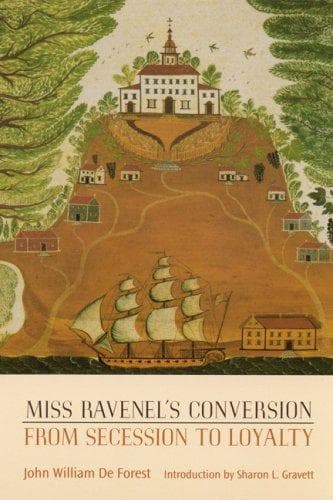
Miss Ravenel's conversion from secession to loyaltyDe Forest, John William
History
Miss Ravenel's conversion from secession to loyalty
De Forest, John William
Historical fiction; United States -- History -- Civil War, 1861-1865 -- Fiction; War stories; Women -- United States -- Fiction
Such was the mild substance of the narrative, but it was horrible in the
telling, with fierce little hisses and glares, sticking out from it like
quills of the fretful porcupine. Miss Ravenel did not sympathize with
the conduct of the fair snubbers, and I fear also that she desired to
make them feel uncomfortable.
"Really," she observed, "I think it was right civil in him to give up
his seat. I didn't know that they were so polite. I thought they treated
the citizens with all sorts of indignities."
To this the Langdons vouchsafed no reply except by rising and taking
their departure.
"Good-day, Miss Ravenel," they said. "So surprised ever to have seen you
in New Orleans again!"
Nor did they ask her to visit them, as they very urgently did Mrs.
Larue. It seemed likely to Lillie that she would not find life in New
Orleans so pleasant as she had expected. Half her old friends had
disappeared, and the other half had turned to enemies. She was to be cut
in the street, to be glared at in church, to be sneered at in the
parlor, to be put on the defensive, to be obliged to fight for herself
and her father. Her temper rose at the thought of such undeserved
hardness, and she felt that if it continued long she should turn loyal
for very spite.
Doctor Ravenel, returning from his interview with Colburne, met the
Langdon ladies in the hall, and, although they hardly nodded, waited on
them to the outer door with his habitual politeness. Lillie caught a
glimpse of this from the parlor, and was infuriated by their incivility
and his lack of resentment.
"Didn't they speak to you, papa?" she cried, running to him. "Then I
would have let them find their own way out. What are you so patient
for?"
"My dear, I am merely following the Christian example set me by these
low Yankees whom we all hate so," said papa, smiling. "I have seen a
couple of officers shamefully insulted to-day by a woman who calls
herself a lady. They returned not a word, not even a look of
retaliation."
"Yes, but--" replied Lillie, and after a moment's hesitation, concluded,
"I wouldn't stand it."
"We must have some consideration, too, for people who have lost
relatives, lost property, lost all, however their folly may have
deserved punishment."
"Havn't _we_ lost property?" snapped the young lady.
"Do you ask for the sake of argument, or for information?"
"Well--I should really like to know--yes, for information," said Lillie,
deciding to give up the argument, which was likely to be perplexing to a
person who had feelings on both sides.
"Our railroad property," stated the Doctor, "won't be worth much until
it is recovered from the hands of the rebels."
"But that is nearly all our property."
"Except this house."
"Yes, except the house. But how are we to live in the house without
money?"
"My dear, let us trust God to provide. I hope to be so guided as to
discover something to do. I have found a friend to-day. Captain Colburne
will be here this evening."
Public-domain text, read in full here on John Shaqi.
Reviews
Reviews
No reviews yet
Be the first to share your thoughts on this work.
Elsewhere in the archive
Join the Discussion
Join the discussion
Sign in to leave a comment or review.
Sign InorCreate an account