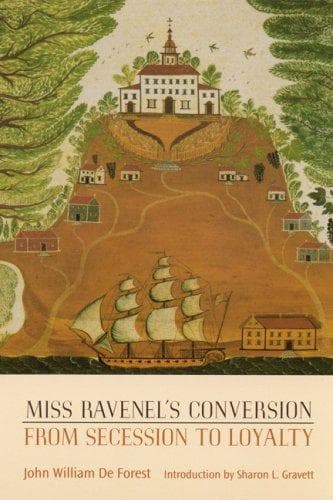
Miss Ravenel's conversion from secession to loyaltyDe Forest, John William
History
Miss Ravenel's conversion from secession to loyalty
De Forest, John William
Historical fiction; United States -- History -- Civil War, 1861-1865 -- Fiction; War stories; Women -- United States -- Fiction
Mrs. Larue did her best to make up for the indifference of Lillie, and
to reward Colburne, not so much for his friendly offices of the evening
previous, as for his other and in her eyes much greater merits of being
young and handsome. The best that the widow could offer, however, was
little to the Captain; indeed had she laid her heart, hand and fortune
at his feet he would only have been embarrassed by the unacceptable
benificence; and he was even somewhat alarmed at the dangerous glitter
of her eyes and freedom of her conversation. It must be understood here
that Madame's devotion to him, fervent as it seemed, was not
whole-hearted. She would have preferred to harness the Colonel into her
triumphal chariot, and had only given up that idea after a series of
ineffectual efforts. Some men can be driven by a cunning hand through
flirtations which they do not enjoy, just as a spiritless horse can be
held down and touched up, to a creditable trot; but Carter was not a nag
to be managed in this way, being too experienced and selfish, too
willful by nature and too much accustomed to domineer, to allow himself
to be guided by a jockey whom he did not fancy. Could she have got at
him alone and often enough she might perhaps have broken him in; for she
knew of certain secret methods of rareyizing gentlemen which hardly
ever fail upon persons of Carter's physical and moral nature; but thus
far she had found neither the time nor the juxtaposition necessary to a
trial of her system. Accordingly she had been obliged to admit, and make
the best of, the fact that he was resolved to do the most of his talking
with Miss Ravenel. Leave the two alone she could not, according to New
Orleans ideas of propriety, and so was compelled for a time to play what
might be called a footman's part in conversation, standing behind and
listening. It was a pleasant relief from this experience to take the
ribbons in her own hands and drive the tractable though reluctant
Colburne. While the Colonel and Lillie talked in the parlor, the Captain
and Mrs. Larue held long dialogues in the balcony. He let her have the
major part of these conversations because she liked it, because he felt
no particular spirit for it, and because as a listener he could glance
oftener at Miss Ravenel. Although a younger man than Carter and a
handsomer one, he never thought to outshine him, or, in common parlance,
to cut him out; holding him in too high respect as a superior officer,
and looking up to him also with that deference which most homebred,
unvitiated youth accord to mature worldlings. The innocent country lad
bows to the courtly roué because he perceives his polish and does not
suspect his corruption. Captain Colburne and Miss Ravenel were similarly
innocent and juvenile in their worshipful appreciation of Colonel
Carter. The only difference was that the former, being a man, made no
secret of his admiration, while the latter, being a marriageable young
Public-domain text, read in full here on John Shaqi.
Reviews
Reviews
No reviews yet
Be the first to share your thoughts on this work.
Elsewhere in the archive
Join the Discussion
Join the discussion
Sign in to leave a comment or review.
Sign InorCreate an account