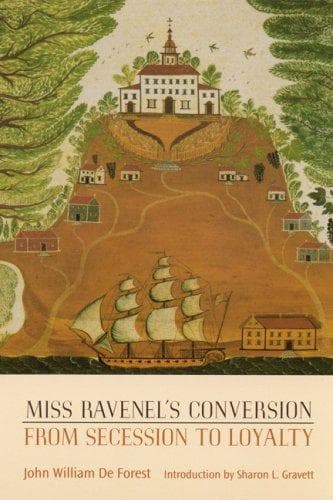
Miss Ravenel's conversion from secession to loyaltyDe Forest, John William
History
Miss Ravenel's conversion from secession to loyalty
De Forest, John William
Historical fiction; United States -- History -- Civil War, 1861-1865 -- Fiction; War stories; Women -- United States -- Fiction
"You really astonish me," confessed the Doctor, whose looks expressed
even more amazement than his language. "I should have considered such a
trade nothing less than treasonable."
"I don't mean to say that it isn't. But I am willing to make allowances
for the parties who engage in it, considering whose auspices they act
under. As I was saying, the trade is contrary to the articles of war. It
is giving aid and comfort to the enemy. But the powers that be, for
unknown reasons which I am of course bound to respect, grant permits to
certain persons to bring about these exchanges. I don't doubt that such
a permit could be obtained for you. Will you accept it?"
"Would you accept it for yourself?" asked the Doctor.
"I am a United States officer," replied the Colonel, squaring his
shoulders. "And a born Virginian gentleman," he was about to add, but
checked himself.
By the way, it is remarkable how rarely this man spoke of his native
State. It is likely enough that he had some remorse of conscience, or
rather some qualms of sentiment, as to the choice which he had made in
fighting against, instead of for, the Old Dominion. If he ever
mentioned her name, it was simply to express his pleasure that he was
not warring within her borders. In other respects it would have been
difficult to infer from his conversation that he was a southerner, or
that he was conscious of being any thing but a graduate of West Point
and an officer of the United States army. But it was only in political
matters that he was false to his birth-place. In his strong passions,
his capacity for domestic sympathies, his strange conscience (as
sensitive on some points as callous on others), his spendthrift habits,
his inclination to swearing and drinking, his mixture in short of
gentility and barbarism, he was a true child of his class and State. He
was a Virginian in his vacillation previous to a decision, and in the
vigor which he could exhibit after having once decided. A Virginian
gentleman is popularly supposed to be a combination of laziness and
dignity. But this is an error; the type would be considered a marvel of
energy in some countries; and, as we have seen in this war, it is
capable of amazing activity, audacity and perseverance. Of all the
States which have fought against the Union Virginia has displayed the
most formidable military qualities.
"And I am a United States citizen," said the Doctor, as firmly as the
Colonel, though without squaring his shoulders or making any other
physical assertion of lofty character.
"Very well.--You mean it, I suppose.--Of course you do.--You are quite
right. It isn't the correct thing, this trade, as a matter of course.
Still, knowing that it was allowed, and not knowing how you might feel
about it, I thought I would offer you the chance. It pays like piracy. I
have known a single smuggle to net forty thousand dollars, after paying
hush money and every thing."
Public-domain text, read in full here on John Shaqi.
Reviews
Reviews
No reviews yet
Be the first to share your thoughts on this work.
Elsewhere in the archive
Join the Discussion
Join the discussion
Sign in to leave a comment or review.
Sign InorCreate an account