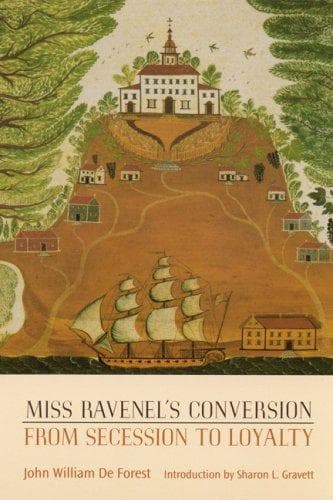
Miss Ravenel's conversion from secession to loyaltyDe Forest, John William
History
Miss Ravenel's conversion from secession to loyalty
De Forest, John William
Historical fiction; United States -- History -- Civil War, 1861-1865 -- Fiction; War stories; Women -- United States -- Fiction
"I wonder why he has such an aversion to the match," she thought.
Accustomed to see men matured in vice lead innocent young girls to the
altar, habituated to look upon the notoriously pure-minded Doctor as a
social curiosity rather than a social standard, she scarcely guessed,
and could not realize, the repugnance with which such a father would
resign a daughter to the doubtful protection of a husband chosen from
the class known as men about town.
"Aurait il découvert," she continued to meditate; "ce petit liaison de
monsieur le colonel? Il est vraiment curieux mon beau-frere; c'est
plutôt une vierge qu'un homme."
I beg the reader not to do this clever lady the injustice to suppose
that she kept or ever intended to keep her promise to the Doctor. To
him, indeed, she did not for a long time speak of the proposed marriage,
intending thereby to lull his suspicions to sleep, and thus prevent him
from offering any timely opposition to that natural course of human
events which might alone suffice to bring about the desired end. But
into Lillie's ears she perpetually whispered pleasant things concerning
Carter, besides leaving the two alone together for ten, fifteen, twenty
minutes at a time, until Lillie would get alarmed at her unusual
position, and become either nervously silent or nervously talkative. For
these services the Colonel was not as grateful as he should have been.
He was just the man to believe that he could make his own way in a love
affair, and need not burden himself with a sense of obligation for any
one's assistance. Moreover, valuing himself on his knowledge of life, he
thought that he understood Mrs. Larue's character perfectly, and
declared that he was not the man to be managed by such an intriguante,
however knowing. He did in fact perceive that she was corrupt, and by
the way he liked her none the worse for it, although he would not have
married her. To Colburne he spoke of her gaily and conceitedly as "the
Larue," or sometimes as "La rouée," for he knew French well enough to
make an occasional bad pun in it. The Captain, on the other hand, never
mentioned her except respectfully, feeling himself bound to treat any
relative of Miss Ravenel with perfect courtesy.
Public-domain text, read in full here on John Shaqi.
Reviews
Reviews
No reviews yet
Be the first to share your thoughts on this work.
Elsewhere in the archive
Join the Discussion
Join the discussion
Sign in to leave a comment or review.
Sign InorCreate an account