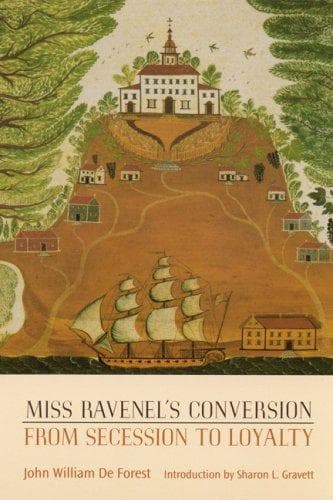
Miss Ravenel's conversion from secession to loyaltyDe Forest, John William
History
Miss Ravenel's conversion from secession to loyalty
De Forest, John William
Historical fiction; United States -- History -- Civil War, 1861-1865 -- Fiction; War stories; Women -- United States -- Fiction
But while Carter supposed that he comprehended the Larue, he walked in
the path which she had traced out for him. From week to week he found
it more agreeable to be with Miss Ravenel. Those random tête-a-têtes
which to her were so alarming, were to him so pleasant that he caught
himself anticipating them with anxiety. The Colonel might have known
from his past experience, he might have known by only looking at his
high-colored face and powerful frame in a mirror, that it was not a safe
amusement for him to be so much with one charming lady. Self-possessed
in his demeanor, and, like most roués, tolerably cool for a little
distance below the surface of his feelings, he was at bottom and by the
decree of imperious nature, very volcanic. As we say of some fiery
wines, there was a great deal of body to him. At this time he was
determined not to fall in love. He remembered how he had been infatuated
in other days, and dreaded the return of the passionate dominion. To use
his own expression, "he made such a blasted fool of himself when he once
got after a woman!"
Nevertheless, he began to be, not jealous; he could not admit that very
soft impeachment; but he began to want to monopolize Miss Ravenel. When
he found Colburne in her company he sometimes talked French to her,
thereby embarrassing and humiliating the Captain, who understood nothing
of the language except when he saw it in print, and could trace out the
meaning of some words by their resemblance to Latin. The young lady,
either because she felt for Colburne's awkward position, or because she
did not wish to be suspected of saying things which she might not have
dared utter in English, usually restored the conversation to her mother
tongue after a few sentences. Once her manner in doing this was so
pointed that the Colonel apologized.
"I beg pardon, Captain," he said, to which he added a white lie. "I
really supposed that you spoke French."
No; Colburne did not speak French, nor any other modern language; he did
not draw, nor sing, nor play, and was in short as destitute of
accomplishments as are most Americans. He blushed at the Colonel's
apology, which mortified him more than the offence for which it was
intended to atone. He would have given all his Greek for a smattering of
Gallic, and he took a French teacher the next morning.
Public-domain text, read in full here on John Shaqi.
Reviews
Reviews
No reviews yet
Be the first to share your thoughts on this work.
Elsewhere in the archive
Join the Discussion
Join the discussion
Sign in to leave a comment or review.
Sign InorCreate an account