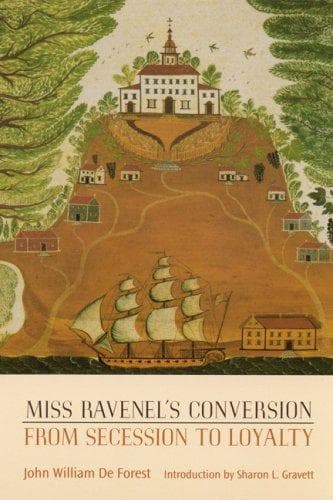
Miss Ravenel's conversion from secession to loyaltyDe Forest, John William
History
Miss Ravenel's conversion from secession to loyalty
De Forest, John William
Historical fiction; United States -- History -- Civil War, 1861-1865 -- Fiction; War stories; Women -- United States -- Fiction
"Oh, these abolitionists! these negar worshippers!" laughed Mrs. Larue,
when the social heretic had taken himself away. "Are they not horrible,
these New England isms? He will be joining the voodoos next. I foresee
that you will have rivals, Mees Lillie. I fear that Mademoiselle Meurice
will carry the day. You are under the disadvantage of being white. Et
puis tu n'est pas descendue d'une race bâtarde. Quel malheur! Je ne
dirais rien s'il entretenait son octaronne a lui. Voilà qui est permis,
bien que ce n'est pas joli."
"Mrs. Larue, I wish you wouldn't talk to me in that way;--I don't like
to hear it," said Lillie, in high anger.
"Mais c'est mieux an moins que de les épouser, les octaronnes,"
persisted Madame.
Miss Ravenel rose and went to her own house and room without answering.
Since her father fled from New Orleans, openly espousing the cause of
the North against the South, she had not been so vexed, so hurt, as she
was by this vulgar conduct of her friend, Captain Colburne. Although it
cannot be said that she had even begun to love him, she certainly did
like him better than any other man that she ever knew, excepting her
father and Colonel Carter. She had thought, also, that he liked her too
well to do anything which would be sure to meet her disapprobation; and
her womanly pride was exceedingly hurt in that her friendship had been
risked for the sake of communion with a race of pariahs. There is little
doubt that Colburne now had small chance with Miss Ravenel. He guessed
as much, and the thought cut him even more deeply that he could have
imagined; but he was too chivalrous to be false to his education, to his
principles, to himself, though it were to gain the heart of the only
woman whom he had ever loved. In fact, so fastidious was his sense of
honor that he had disdained to fortify himself against Mrs. Larue's
attack by stating, as he might have done truthfully, that at one of
these Meurice dinners he had sat by the side of Colonel Carter.
I consider it worth while to mention here that Colburne committed a
great mistake about this time in declining a regiment which the eldest
Meurice offered to raise for him, providing he would apply for the
colonelcy. But it was not for fear of Mrs. Larue nor yet of Miss Ravenel
that he declined the proffer. He took the proposition into serious
consideration and referred it to Carter, who advised him against it.
Public opinion on this subject had not yet become so overpoweringly
luminous that the old regular, the West Point Brahmin, could see the
negro in a military light.
Public-domain text, read in full here on John Shaqi.
Reviews
Reviews
No reviews yet
Be the first to share your thoughts on this work.
Elsewhere in the archive
Join the Discussion
Join the discussion
Sign in to leave a comment or review.
Sign InorCreate an account