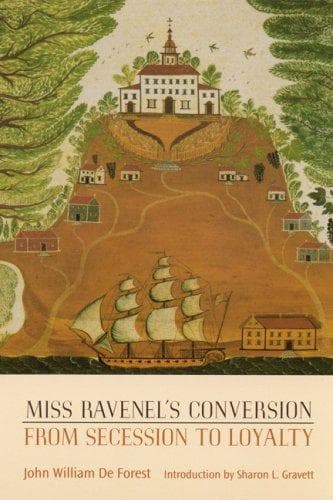
Miss Ravenel's conversion from secession to loyaltyDe Forest, John William
History
Miss Ravenel's conversion from secession to loyalty
De Forest, John William
Historical fiction; United States -- History -- Civil War, 1861-1865 -- Fiction; War stories; Women -- United States -- Fiction
"When this war broke out he came home to see if he might be permitted to
fight for his race, and for his and my country. He now wears the same
uniform that I do, and he is my superior officer."
"It is shameful," broke out Lillie.
"It is the will of authority," answered Colburne,--"of authority that I
have sworn to respect."
"A southern gentleman would resign," said Mrs. Larue.
"A northern gentleman keeps his oath and stands by his flag," retorted
Colburne.
Mrs. Larue paused, suppressed her rising excitement, and with an
exterior air of meekness considered the situation. She had gained her
battle; she had wounded and punished him; she had probably detached
Lillie from him; now she would stop the conflict.
"I beg pardon," she said, looking him full in the eyes with a charming
little expression of penitence. "I am sorry if I have annoyed you. I
thought, I hoped, you might perhaps be obliged to me for hinting to you
that these people are not received here in society. You are a stranger,
and do not know our prejudices. I pray you to excuse me if I have been
officious."
Colburne was astonished, disarmed, ashamed, notwithstanding that he had
been in the right and was the injured party.
"Mrs. Larue, I beg your pardon," he answered. "I have been unnecessarily
excited. I sincerely ask you pardon."
She accorded it in pleasant words and with the most amiable of smiles.
She was a good-natured, graceful little grimalkin, she could be pretty
and festive over a mouse while torturing it; so purring and
velvet-pawed, indeed, that the mouse himself could not believe her to be
in earnest, and prayed to be excused for turning upon her. It is
probable that, not being susceptible to keen emotions, she did not know
what deep pain she had given the young man by her attack. The advantage
which blasé people have over innocents in a fight is awful. They know
how to hit, and they don't mind the punishing. It is said that Deaf
Burke's physiognomy was so calloused by frequent poundings that he would
permit any man to give him a facer for a shilling a crack.
Lillie said almost nothing during the conversation, being quite overcome
with amazement and anger at Colburne's degradation and at the
wrongheadedness, the indelicacy, the fanaticism with which he defended
it. When the erring young man left the house she did not give him her
hand, after her usual friendly southern fashion. The pride of race, the
prejudices of her education, would not permit her to be cordial, at
least not in the first moments of offence, with one who felt himself at
liberty to go from her parlor to that of an octoroon. How could a Miss
Ravenel put herself on a level with a Miss Meurice.
Public-domain text, read in full here on John Shaqi.
Reviews
Reviews
No reviews yet
Be the first to share your thoughts on this work.
Elsewhere in the archive
Join the Discussion
Join the discussion
Sign in to leave a comment or review.
Sign InorCreate an account