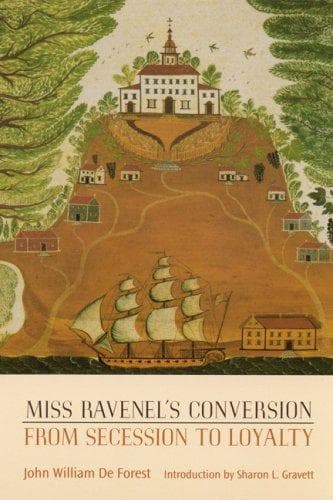
Miss Ravenel's conversion from secession to loyaltyDe Forest, John William
History
Miss Ravenel's conversion from secession to loyalty
De Forest, John William
Historical fiction; United States -- History -- Civil War, 1861-1865 -- Fiction; War stories; Women -- United States -- Fiction
"It is like going through a milliner's shop," said Lillie. "How nicely
the things are folded! They really have a great deal of taste in
arranging the colors. See, here is blue and red and grey, and then blue
again, with a black cravat here and a white handkerchief there. It is
like the backs of a row of books."
"Yes, this box knapsack is a good one for show," the Colonel admitted.
"It is too large, however. When the men come to march they will find
themselves overloaded. I shall have to make a final inspection and throw
away a few tons of these extra-military gewgaws. What does a soldier
want of black cravats and daguerreotypes and diaries and Testaments?"
"How cruelly practical you are!" said Lillie.
"Not in every thing," responded the Colonel with a sigh; and for some
reason the young lady blushed profoundly at the answer.
Of course these visits, the regiment, the Reserve Brigade, and its
destination were matters of frequent conversation at the Ravenel
dwelling. Through some leak of indiscretion or treachery it transpired
that Weitzel was to oust Mouton from the country between the Mississippi
and the Atchafalaya, where he was a constant menace to New Orleans. The
whole city, rebel and loyal, argued and quarreled about the chances of
success. The Secessionists were rampant; they said that Mouton had
fifteen thousand men; they offered to bet their piles that he would have
New Orleans back in a month. At every notable corner and in front of
every popular drinking saloon were groups of tall, dark, fierce-looking
men, carrying heavy canes, who glared at Union officers and muttered
about coming Union defeats. Pale brunette ladies flouted their skirts
scornfully at sight of Federal uniforms, and flounced out of omnibusses
and street cars defiled by their presence. These feminine politicians
never visited Miss Ravenel, however intimately they might have known her
before the war; and if they met her in the street they complimented her
with the same look of hate which they vouchsafed to the flag of their
country. With Madame Larue they were still on good terms, although they
rarely called at her house for fear of encountering the Ravenels. This
suited Madame's purposes precisely; she could thereby be Federal at home
and Secessionist abroad.
"You know, my dears," she would say to the female Langdons and Soulés,
"that one cannot undo one's self of one's own relatives. That would be
unreasonable. So I am obliged to receive the Doctor and his poor
daughter at my house. But I understand perfectly that their society must
be to you disagreeable. Therefore I absolve you, though with pain, from
returning my visits. But, my dears, I shall only call on you the more
often. Do not be surprised," she would sometimes add, "if you see a
Federal uniform enter my door from time to time. I have my objects. I
flatter myself that I shall yet be of benefit to the good cause."
Public-domain text, read in full here on John Shaqi.
Reviews
Reviews
No reviews yet
Be the first to share your thoughts on this work.
Elsewhere in the archive
Join the Discussion
Join the discussion
Sign in to leave a comment or review.
Sign InorCreate an account