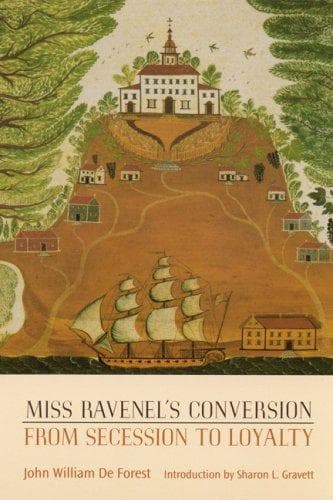
Miss Ravenel's conversion from secession to loyaltyDe Forest, John William
History
Miss Ravenel's conversion from secession to loyalty
De Forest, John William
Historical fiction; United States -- History -- Civil War, 1861-1865 -- Fiction; War stories; Women -- United States -- Fiction
And in fact she did occasionally send to a certain secret junto scraps
of information which she professed to have extracted from Union
officers. This information was of no value; it is even probable that
much of it was a deliberate figment of her imagination; but in this way
she kept her political odor sweet in the nostrils of the city
Secessionists.
In secret she cared for little more than to be on the safe side and keep
her property. She laughed with delighted malice at the Doctor's sarcasms
upon the absurdities of New Orleans politics, and the rottenness of New
Orleans morals. She sympathized with Lillie's youthful indignation at
her own social proscription. She flattered Carter's professional pride
by predicting his success in the field. She satirized Colburne behind
his back, and praised him to his face, for his Catonian principles. She
was all things to all men, and made herself generally agreeable.
Meantime Lillie had become what she called a Federalist; for she was not
yet so established in the faith as to style it Loyalist or Patriot. What
girl would not have been thus converted, driven as she was from the
mansion of secession by its bitter inmates, and drawn towards the
opposing house by her father and her two admirers? Colonel Carter's
visits were frequent and his influence strong and increasing,
notwithstanding the Doctor's warning tirades. It made her uneasy,
fretful and unhappy, to disagree with her father; but on the subject of
this preference she positively could not hold his opinions. He seemed to
her to be so unjust; she could not understand why he should be so
bitterly and groundlessly prejudiced; the reasons which he hinted at
glided off her like rain off a bird's feathers. She granted no faith to
the insinuation that the Colonel was a bad man, nor, had she credited
it, would she have inferred therefrom that he would make a bad husband.
Let us not be astonished at the delusion of this intelligent and
pure-minded young lady. I have witnessed more extraordinary assortments
and choices than this. I have more than once seen an elegant, brilliant,
highly-cultured girl make an inexplicable and hungry snap at a man who
was stupidly, boorishly, viciously her inferior. The subtle and potent
sense which draws the two sexes together is an inexorable despot.
Public-domain text, read in full here on John Shaqi.
Reviews
Reviews
No reviews yet
Be the first to share your thoughts on this work.
Elsewhere in the archive
Join the Discussion
Join the discussion
Sign in to leave a comment or review.
Sign InorCreate an account