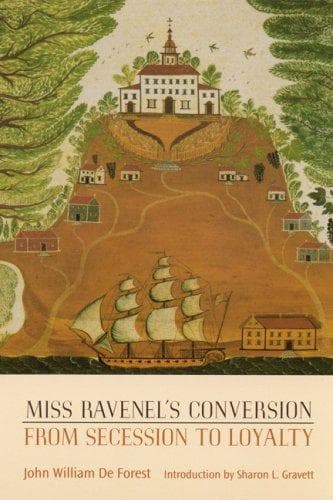
Miss Ravenel's conversion from secession to loyaltyDe Forest, John William
History
Miss Ravenel's conversion from secession to loyalty
De Forest, John William
Historical fiction; United States -- History -- Civil War, 1861-1865 -- Fiction; War stories; Women -- United States -- Fiction
The Colonel was one of its victims, although not quite bereft of reason.
Still, if he did not offer himself to Miss Ravenel before going on this
Lafourche expedition, it was simply from considerations of worldly
prudence, or, as he phrased it to himself, out of regard to her
happiness. He thought that his pay was insufficient to support her in
the style to which she had been accustomed, and in which he wished his
wife to live. That he would be rejected he did not much expect, being a
veteran in love affairs, accustomed to conquer, and gifted by birthright
with an audacious confidence. Nor did he so much as suspect that he was
not good enough for her. His moral perceptions, not very keen perhaps by
nature, had been still further calloused by thirty-five years of
wandering in the wilderness of sin. Strange as it may seem to people of
staid lives the Colonel did not even consider himself a fast man. He
allowed that he drank; yes, that he sometimes drank more than was good
for him; but, as he laughingly said, he never took more than his
regulation quart a day; by which he meant that, according to the army
standard, he was a temperate drinker. As to gambling, that was a
gentleman's amusement, and moreover he had done very little of it in the
last year or two. It was true that he had had various----; but then all
men did that sort of thing at times and under temptation; they did it
more or less openly, according as they were men of the world or
hypocrites; if they said they didn't, they lied. The Colonel did not
grant the least faith to the story of Joseph, or, allowing it to be
true, for the sake of argument, he considered Joseph no gentleman. In
short, after inspecting himself fairly and fully according to his
lights, he concluded that he was rather honorable even in his vices. Had
he not, for instance, entangled himself in that affair of the French
_boudoir_ chiefly to get Miss Ravenel out of his head, and so keep from
leading her and himself into a poverty-stricken marriage? Thus, though
he was very frank with himself, he still concluded that he was a
tolerably good fellow. Yes; and there were many other persons who
thought him good enough; men who knew his ways perfectly but could not
see much matter of reproach in them.
Public-domain text, read in full here on John Shaqi.
Reviews
Reviews
No reviews yet
Be the first to share your thoughts on this work.
Elsewhere in the archive
Join the Discussion
Join the discussion
Sign in to leave a comment or review.
Sign InorCreate an account