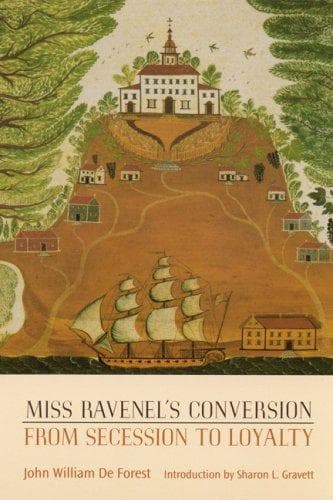
Miss Ravenel's conversion from secession to loyaltyDe Forest, John William
History
Miss Ravenel's conversion from secession to loyalty
De Forest, John William
Historical fiction; United States -- History -- Civil War, 1861-1865 -- Fiction; War stories; Women -- United States -- Fiction
He ceased his walk and gazed eagerly at her, hoping for some affirmative
sign. As may be supposed Lillie could not give it; she could make no
very distinct signs just then, either one way or the other; she did not
speak, nor look at him, nor shake her head, nor nod it; she only covered
her face with her hands, and sobbed. Then the Doctor, feeling himself to
be forsaken, and acknowledging it by outward dumb show, after the manner
of men who are greatly moved, went to the other end of the room, sat
down by himself and dropped his head into his hands, as if accepting
utter loneliness in the world. Lillie gave him one glance in his
acknowledged extremity of desertion, and, running to him, knelt at his
feet and laid her head against his. She was certainly the most unhappy
of the two, but her eagerness was even stronger than her misery.
"Oh papa! _Why_ do you hate him so?"
"I don't hate him. I dread him. I suspect him. I know he will not make
you happy. I know he will make you miserable."
"But why?--_why?_ Perhaps he can explain it. Tell him what you think,
papa. I am sure he can explain every thing."
But the Doctor only groaned, rose up, disentangled himself from his
daughter, and leaving her there on the floor, continued his doleful
walk.
Never having really feared what had come to pass, but only given
occasional thought to it as a possible though improbable calamity, he
had not inquired strictly into Carter's manner of life, and so had
nothing definite to allege against him. At the same time he knew
perfectly well from trifling circumstances, incidental remarks, general
air and bearing, that he was one of the class known in the world as "men
about town:" a class not only obnoxious to the Doctor's moral sentiments
as the antipodes of his own purity, but also as being a natural product
of that slaveholding system which he regarded as a compendium of
injustice and wickedness; a class the members of which were constantly
coming to grief and bringing sorrow upon those who held them in
affection. He knew them; he had watched and disliked them since his
childhood; he was familiar by unpleasant observation with their
language, feelings, and doings; he knew where they began, how they went
on, and in what sort they ended. The calamities which they wrought for
themselves and all who were connected with them he had witnessed in a
hundred similar, and, so to speak, reflected instances. He remembered
young Hammersley, who had sunk down in drunken paralysis and burned his
feet to a crisp at his father's fire. Young Ellicot had dashed out his
brains by leaping from a fourth story window in a fit of delirium
tremens. Tom Akers was shot dead while drunk by a negro whom he had
horribly tortured. Fred Sanderson beat his wife until she left him,
spent his property at bars and gaming-tables and died in Cuba with
Walker. Others he recollected, by the dozen, it seemed to him, who had
fallen, wild with whiskey, in grog-shop broils or savage street
rencontres.
Public-domain text, read in full here on John Shaqi.
Reviews
Reviews
No reviews yet
Be the first to share your thoughts on this work.
Elsewhere in the archive
Join the Discussion
Join the discussion
Sign in to leave a comment or review.
Sign InorCreate an account