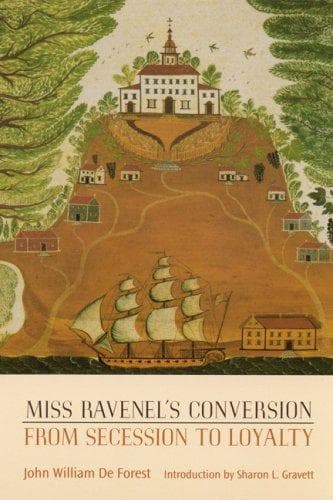
Miss Ravenel's conversion from secession to loyaltyDe Forest, John William
History
Miss Ravenel's conversion from secession to loyalty
De Forest, John William
Historical fiction; United States -- History -- Civil War, 1861-1865 -- Fiction; War stories; Women -- United States -- Fiction
Those who lived to grow old had slave-born children, whom
they either shamelessly acknowledged, or more shamelessly ignored, and
perhaps sold at the auction-block. They were drunkards, gamblers,
adulterers, murderers. Of such was the kingdom of Hell. And this man, to
whom his only child, his Lillie, had entrusted her heart, was, he
feared, he almost knew, one of that same class, although not, it was to
be hoped, so deeply stained with the brutish forms of vice which flow
directly from slavery. He could not entrust her to him; he could not
accept him as a son. At the same time he could not in this interview
make any distinct charges against his life and character. Accordingly
his talk was vague, incoherent, and sounded to Lillie like the frettings
of groundless prejudice. The painful interview lasted above an hour,
and, so far as concerned a decision, ended precisely where it began.
"Go to your bed, my child," the Doctor said at last. "And go to sleep if
you can. You will cry yourself sick."
She gave him a silent kiss, wet with tears, and went away with an aching
heart and a wearied frame.
For two hours or more the Doctor continued his miserable walk up and
down the study, from the door to the window, from corner to corner,
occasionally stopping to rest a tired body which yet had no longing for
slumber. He went back over his daughter's life, beginning with the
infantile days when he used to send the servant away from the cradle in
which she lay, and rock it himself for the pure pleasure of watching
her. He remembered how she had expanded into the whole of his heart when
her mother died. He thought how solely he had loved her since that
bereavement, and how her love for him had grown with her growth and
strengthened with every maturing power of her spirit. In the enthusiasm,
the confidence of this recollection, he did not doubt at moments but
that he could win her back to himself from this misplaced affection. She
was so young yet, her heart must be so pliable yet, that he could surely
influence her. As this comforting hope stole through him he felt a
desire to look at her. Yes, he must see her again before he could get
to sleep; he would go gently to her room and gaze at her without waking
her. Putting on his slippers, he crept softly up stairs and opened her
door without noise. By the light of a dying candle he saw Lillie in her
night dress, sitting up in bed and wiping the tears from her cheeks with
her hands.
"Papa!" she said in an eager gasp, tremulous with affection, grief and
hope.
"Oh, my child! I thought you would be asleep," he answered, advancing to
the bedside.
"You are not very angry with me?" she asked, making him sit down by her.
"No; not angry. But so grieved!"
"Then may he not write to me?"
She looked so loving, so eager, so sorrowful that he could not say No.
"Yes; he may write."
She drew his head towards her with her wet hands, and gave him a kiss
the very gratitude of which pained him.
Public-domain text, read in full here on John Shaqi.
Reviews
Reviews
No reviews yet
Be the first to share your thoughts on this work.
Elsewhere in the archive
Join the Discussion
Join the discussion
Sign in to leave a comment or review.
Sign InorCreate an account