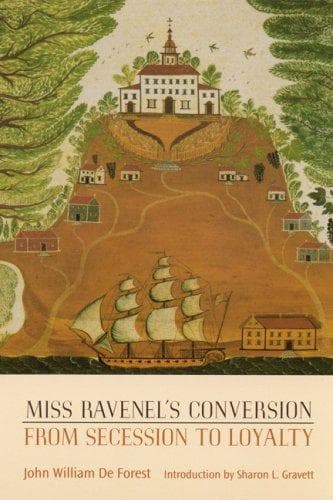
Miss Ravenel's conversion from secession to loyaltyDe Forest, John William
History
Miss Ravenel's conversion from secession to loyalty
De Forest, John William
Historical fiction; United States -- History -- Civil War, 1861-1865 -- Fiction; War stories; Women -- United States -- Fiction
"That reminds me of a chaffering which I overheard in a country tavern
in Georgia between a Yankee peddler and an indigenous specimen. The
Cracker wanted to sell the stranger a horse. 'I don't care particularly
for a trade,' says the Yankee, 'but I'll buy the shoes if you'll throw
in the creetur.' Medicine is a great science; but mineralogy is a far
vaster one."
In short, the Doctor was to Madame like a cold cake to a lump of butter;
he calmly endured her, but gave her no encouragement to melt upon his
bosom. Just at this time he was more than usually safe from love
entanglements because he was so anxious about Lillie's position and
prospects. He made what inquiries he could concerning Carter's way of
life, and watched his demeanor and conversation closely while talking to
him with the politest of smiles. He was unexpectedly gratified by
discovering that his proposed son-in-law led--at least for the
present--a sober and decent life. With his devotion as a lover no fault
could be found by the most exacting of fathers. He called on Lillie
every evening and sent her flowers every morning; in short, he bloomed
with fair promise of being an affectionate and even uxorious husband.
Gradually the Doctor weaned himself from his selfish or loving
suspicions, and became accustomed to the idea that from this man his
daughter might draw a life-long happiness. Thus when it happened, late
in January, nearly four months after the declaration, that Carter
requested to be informed definitely as to his prospects, he obtained
permission to consider the affair an engagement.
"You know I can't promise wealth to Miss Ravenel," he said frankly.
"She may have to put up with a very simple style of life."
"If she can't be contented, I shall not pity her," answered the Doctor.
"I don't believe that the love of money is the root of all evil. But I
do say that it is one of the most degrading passions conceivable in
woman. I sympathise with no woman whose only trouble is that she cannot
have and spend a great deal of money. By the way, you know how unable I
am to endow her."
"Don't mention it. You have already endowed her. The character that you
have transmitted to her, sir--"
The Doctor bowed so promptly and appreciatively that the Colonel did not
feel it necessary to round off the compliment.
As men do not talk copiously with each other on these subjects, the
interview did not last ten minutes.
Public-domain text, read in full here on John Shaqi.
Reviews
Reviews
No reviews yet
Be the first to share your thoughts on this work.
Elsewhere in the archive
Join the Discussion
Join the discussion
Sign in to leave a comment or review.
Sign InorCreate an account