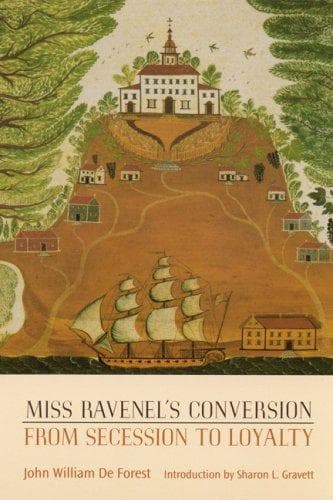
Miss Ravenel's conversion from secession to loyaltyDe Forest, John William
History
Miss Ravenel's conversion from secession to loyalty
De Forest, John William
Historical fiction; United States -- History -- Civil War, 1861-1865 -- Fiction; War stories; Women -- United States -- Fiction
I hope that I shall not impress the reader unfavorably concerning
Lillie's character when I state that she was frankly happy over the
result of her lover's probation. Her delight did not arise merely from
the prospect of a smooth course of love and marriage. It sprang in part
from the greatly comforting fact that now there was no difference of
opinion, no bar to perfect sympathy, between her and that loved,
respected, almost adored papa. I have given a very imperfect idea of her
if I have not already made it clear that with her the sentiment of
filial affection was almost a passion. From very early childhood she had
been remarkable for papa-worship, or whatever may be the learned name
for the canonization of one's progenitors. At the age of seven she had
propounded the question, "Mamma, why don't they make papa President of
the United States?" Some light may be shed on the character of this
departed mother and wife by stating that her answer was, "My dear, your
father never chose to meddle in politics." Whether Mrs. Ravenel actually
deified the Doctor with all the simple faith of the child, or whether
the reply was merely meant to confirm the latter in her filial piety,
is a matter of doubt even to persons who were well acquainted with the
deceased lady.
At last Lillie could prattle to her father about Carter as much as she
liked; and she used the privilege freely, being habituated to need,
demand and obtain his sympathies. Not that she filled his ears with
confessions of love, or said that Colonel Carter was "_so_ handsome!" or
anything of that sickish nature. But when her father came in from a
walk, it was, "Papa, did you see Mr. Carter anywhere? And what did he
say?" At another time it was, "Papa, did Mr. Carter ever tell you about
his first campaign against the Indians?" And then would follow the
story, related with glee and a humorous appreciation of the
grandiloquent ideas of a juvenile West Pointer about to draw his maiden
sword. A frequent subject of her conversation was Carter's chance of
promotion, not considered with regard to the pecuniary advantages
thereof, but in respect to the simple justice of advancing such an able
and gallant officer. It was, "Papa, how can the Government be so stupid
as to neglect men who know their duties? Mrs. Larue says that the
abolitionists are opposed to Mr. Carter because he doesn't hold their
ultra opinions. I suppose they would rather favor a man who talks as
they do, even if he got whipped every time, and never freed a nigger. If
Mr. Carter were on the southern side, he would find promotion fast
enough. It is enough to make any one turn rebel."
Public-domain text, read in full here on John Shaqi.
Reviews
Reviews
No reviews yet
Be the first to share your thoughts on this work.
Elsewhere in the archive
Join the Discussion
Join the discussion
Sign in to leave a comment or review.
Sign InorCreate an account